
075582814553

The most significant difference in the transistor c1815 vs c945 comparison centers on current gain. The C1815 offers a higher and wider gain range, making it ideal for circuits that demand strong amplification and low noise, such as audio preamplifiers. Both transistors share similar voltage and current ratings, but each excels in different roles. Selecting the right transistor directly impacts circuit performance, especially when signal clarity or voltage tolerance matters.
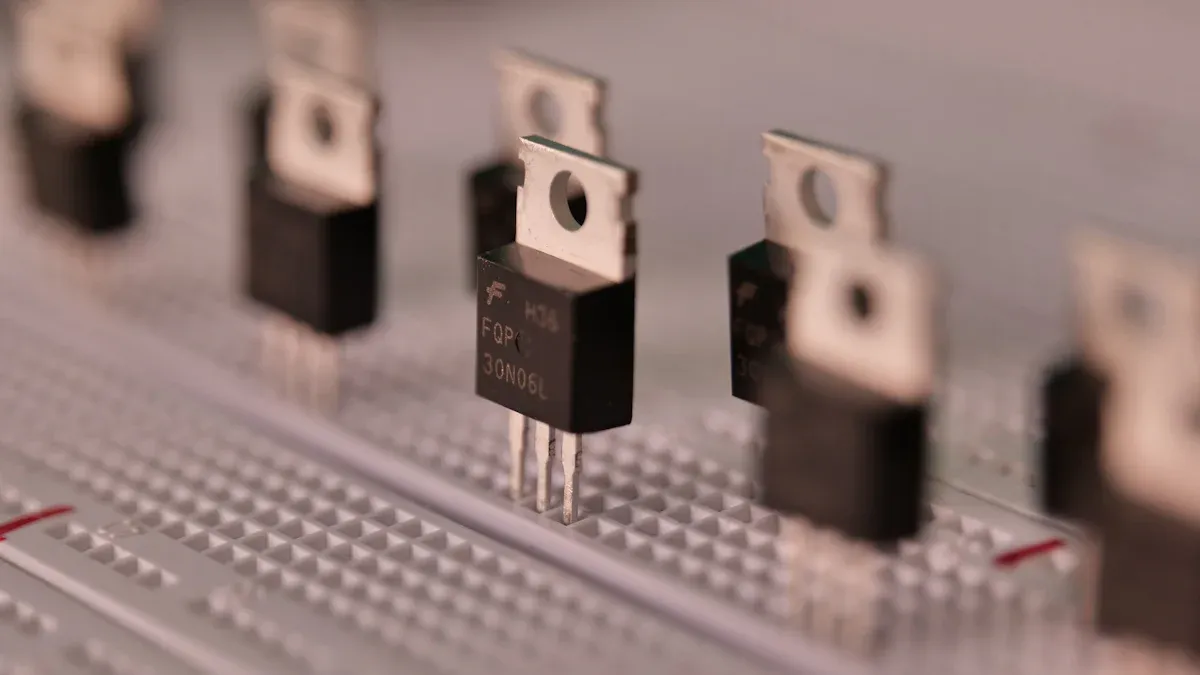
The C1815 transistor stands out as a versatile NPN bipolar junction transistor. Engineers often select it for its strong amplification and low noise characteristics. The device supports a collector-base voltage up to 50 V and a collector current up to 150 mA. Its current gain (hFE) ranges from 70 to 700, depending on the subtype. This wide gain range allows for flexibility in circuit design. The C1815 features a high transition frequency, typically around 80 MHz, which makes it suitable for high-frequency applications. Its low noise performance makes it a preferred choice for audio preamplifiers and amplifiers. The table below summarizes its key specifications:
| Specification | Details / Values |
|---|---|
| Transistor Type | NPN Bipolar Junction Transistor |
| Collector-Base Voltage (V_CBO) | Up to 50 V |
| Collector Current (Ic) | Up to 150 mA |
| Current Gain (hFE) | 70 to 700 (varies by subtype) |
| Power Dissipation | Moderate power applications |
| Noise Level | Low noise, ideal for audio |
| Transition Frequency (fT) | Around 80 MHz |
| Pinout | Emitter (E), Base (B), Collector (C) |
| Applications | Audio, switching, sensor, RF circuits |
The C945 transistor also belongs to the NPN bipolar junction family. It shares many similarities with the C1815, including voltage and current ratings. The C945 typically offers a collector-emitter voltage up to 50 V and a collector current up to 150 mA. Its current gain is slightly lower and more consistent, making it reliable for general-purpose amplification and switching. The C945 performs well in low to moderate power circuits. Designers often use it in audio and signal processing circuits, where stable gain and dependable operation are important.
Audio amplification, including preamplifiers and small audio amplifiers
Signal processing tasks such as amplification and filtering
Switching loads under 150 mA, including relays, small motors, and LEDs
Sensor circuits to amplify weak sensor signals
RF circuits for oscillation, amplification, and modulation
Push-pull amplifier configurations to improve efficiency and reduce distortion
Driver stage amplifiers to provide sufficient current and voltage to subsequent stages
Both the C1815 and C945 transistors serve as reliable choices for general-purpose amplification and switching. In the transistor c1815 vs c945 comparison, each device brings unique strengths to modern electronics, allowing engineers to select the best fit for their specific application.
A clear understanding of the electrical specifications helps engineers select the right transistor for their projects. The table below compares the main parameters of the C1815 and C945 transistors:
| Parameter | C1815 | C945 |
|---|---|---|
| Transistor Type | NPN | NPN |
| Collector-Emitter Voltage | 50V | 50V |
| Collector-Base Voltage | 60V | 60V |
| Emitter-Base Voltage | 5V | 5V |
| Maximum Collector Current | 150mA | 150mA |
| Typical Gain (hFE) | 70 to 700 | Comparable, often 70–700 |
| Transition Frequency (fT) | ~80 MHz | 150–300 MHz |
| Noise Level | Very low, ideal for audio | Low, suitable for audio |
Tip: Both transistors share similar voltage and current ratings, making them suitable for low-power circuits. However, their gain and frequency characteristics set them apart for specific uses.
The current gain (hFE) of a transistor determines how much it can amplify a signal. The C1815 offers a wide gain range from 70 to 700, which provides flexibility for designers who need strong amplification or want to fine-tune circuit performance. The C945 also delivers high gain, typically within a similar range, but datasheets often highlight the C1815 for its superior linearity and consistency in audio circuits.
Transition frequency (fT) measures how fast a transistor can operate. The C1815 has a transition frequency of about 80 MHz. This value supports most audio and low-frequency applications. The C945, on the other hand, boasts a much higher transition frequency, ranging from 150 MHz to 300 MHz. This higher fT allows the C945 to perform better in circuits that require fast switching or operation at higher frequencies, such as RF (radio frequency) circuits.
C1815: Best for applications needing stable gain and low noise, especially in audio.
C945: Preferred for high-frequency circuits and fast switching tasks.
Both the C1815 and C945 transistors can handle a collector-emitter voltage of up to 50V and a maximum collector current of 150mA. This similarity means that either device can serve in low-power switching and amplification roles without concern for overloading.
Note: The matching voltage and current ratings make it easy to substitute one for the other in many basic circuits, but always check the gain and frequency requirements first.
Choose the C1815 when low noise and high gain are critical, such as in audio preamplifiers or sensitive signal processing.
Select the C945 for circuits that demand higher frequency response, like RF amplifiers or fast digital switching.
For general-purpose amplification or switching below 150mA, both transistors perform reliably.
The transistor c1815 vs c945 comparison shows that while both devices share core electrical specs, their differences in gain linearity, noise, and frequency response make each one better suited for specific applications.
The transistor c1815 vs c945 comparison highlights important differences in real-world circuit performance. The C1815 transistor stands out in audio amplifier circuits. Designers often choose it for preamplifiers and headphone amplifiers because it delivers stable gain and clear sound. Technical reviews and user feedback confirm that the C1815 amplifies audio signals with reliability and minimal noise. Many engineers pair the C1815 with the A1015 transistor in push-pull AB class amplifiers. This combination helps reduce distortion and improves audio quality.
The C945 transistor also performs well in audio circuits. It features low noise and high DC gain, making it suitable for boosting and shaping audio signals. Its low saturation voltage allows it to operate efficiently in low-voltage circuits. However, the C1815 often receives preference in designs where clarity and low noise are critical.
In switching applications, both transistors handle up to 150mA collector current and 50V collector-emitter voltage. The C945 offers a higher transition frequency, which allows it to switch faster in digital and RF circuits. This makes the C945 a strong choice for high-frequency switching tasks.
The table below summarizes their performance in key roles:
| Application Type | C1815 Performance | C945 Performance |
|---|---|---|
| Audio Amplifiers | Clear, stable gain; low noise; preferred for clarity | Reliable; low noise; suitable for low-voltage circuits |
| Switching | Reliable for low-power switching | Fast switching; better for high-frequency applications |
| High-Frequency/RF | Good, but limited by lower transition frequency | Excellent due to higher transition frequency |
Note: The C1815 excels in audio and low-noise circuits, while the C945 leads in high-frequency and fast-switching roles.
Selecting between the C1815 and C945 depends on the specific needs of the project. The transistor c1815 vs c945 decision often comes down to noise performance, gain linearity, and frequency response.
The C1815 is ideal for:
Audio preamplifiers and small audio amplifiers
Sensor circuits that require low noise and stable gain
RF circuits where moderate frequency operation is needed
Driver stages in amplifiers
The C945 is best suited for:
Audio frequency amplifiers in low-voltage environments
Circuits that demand fast switching, such as digital logic or RF switching
Applications where high transition frequency is a priority
Technical sources and user experiences show that the C1815 provides excellent hFE linearity and low noise. These features make it the preferred choice for audio and signal processing circuits. The C945, with its higher transition frequency, fits better in circuits that require rapid switching or operation at higher frequencies.
Tip: Always match the transistor's strengths to the circuit's requirements. For audio clarity and low noise, choose the C1815. For speed and high-frequency tasks, select the C945.
The transistor c1815 vs c945 comparison demonstrates that both devices serve well in general-purpose roles. However, their unique strengths make each one better suited for certain applications. Careful selection ensures optimal circuit performance and reliability.
Engineers often consider substituting a C1815 with a C945 in low current amplification and switching circuits. Both transistors share similar electrical characteristics, such as maximum collector current and voltage ratings. The C945 is widely recognized as an equivalent for the C1815 in pre-amplification and audio frequency applications. This makes it a practical choice for general-purpose amplification, small signal switching, and sensor circuits, provided the circuit does not exceed 150mA.
⚡ Tip: Always check the pin configuration before substitution. Both transistors use an Emitter-Collector-Base (E-C-B) layout, but the orientation may differ depending on the manufacturer.
The table below summarizes key considerations when substituting:
| Consideration Aspect | C1815 Characteristics | C945 Characteristics and Issues |
|---|---|---|
| Pin Configuration | Emitter-Collector-Base (E-C-B) | Emitter-Collector-Base (E-C-B), orientation must be verified |
| Electrical Parameters | Low noise, high-frequency operation, moderate power | Different gain and power ratings; may affect performance |
| Base Resistor Requirement | Important to use to prevent damage | Also important; lack of base resistor can damage transistor |
| User Experience | Works reliably in circuits designed for it | May fail in some circuits due to pin orientation or electrical differences |
Electronics experts recommend using the C945 as a substitute in circuits where the gain, voltage, and current requirements match. This includes most audio preamplifiers, signal amplifiers, and low-power switching circuits.
Direct substitution does not always guarantee reliable operation. Differences in pinout orientation can cause wiring errors, leading to circuit malfunction. Even though both transistors support similar voltage and current ratings, small differences in voltage tolerance or gain may impact sensitive circuits, especially in high-frequency or precision audio designs.
| Parameter | C1815 | C945 |
|---|---|---|
| Pinout | May differ by manufacturer | May differ by manufacturer |
| Collector-Base Voltage | Typically around 50V | Typically around 60V |
| Collector Current | Around 150mA | Around 150mA |
| Current Gain (hFE) | Varies by batch | Varies by batch |

 Catalogue
 FPGA / CPLD
 Memory
 MOS
MOS  MCU
MCU  DSP
DSP OCEP
OCEP Secondary
  Other
Other 


