
075582814553

Have you ever wondered how precise current measurements are made in the complex world of automotive systems and power electronics? The answer often lies with a small yet mighty component: the shunt resistor. These unsung heroes are critical for ensuring the safe, efficient, and accurate operation of countless devices, from electric vehicle battery management systems to industrial power supplies. Without them, monitoring and controlling the flow of electricity in high-power scenarios would be a significant challenge, leading to inefficiencies, potential damage, and even safety hazards.
This comprehensive guide is tailored for engineering professionals seeking accurate current sensing solutions. We’ll delve into the fundamentals of shunt resistors, explore the crucial criteria for selecting the right one, and examine their industry-specific applications in both automotive and power electronics. By the end of this article, you’ll have a deeper understanding of how these components work and how to effectively integrate them into your designs.
1.0 What are Shunt Resistors?
2.0 Shunt Resistor vs. Current Sense Resistor
3.0 How to Select the Right Shunt Resistor (Key Specifications and Considerations)
4.0 Shunt Resistor Calculation and Sizing
5.0 High-Precision Shunt Resistors and Kelvin Connections
6.0 Applications of Shunt Resistors in the Automotive Industry
7.0 Applications of Shunt Resistors in Power Electronics
8.0 Measurement Techniques and Troubleshooting Tips
9.0 Comparing Shunt Resistor Options and Manufacturer Specifications
10.0 Conclusion
At its core, a shunt resistor is a low-resistance component specifically designed to measure electric current. It operates on the fundamental principle of Ohm’s Law (V = I·R), where a known, precise resistance (R) is placed in series with the circuit where current (I) needs to be measured. By accurately measuring the voltage drop (V) across this resistor, the current flowing through the circuit can be precisely determined. The beauty of a shunt resistor lies in its ability to allow the vast majority of the current to flow through it, creating only a minimal voltage drop, thereby having a negligible impact on the overall circuit’s operation.
A shunt resistor, often referred to simply as a ‘shunt,’ provides a low-impedance path for current. Imagine a river where you want to measure the flow. Instead of blocking the river, you create a small, controlled bypass with a known width. By measuring the water level difference across this bypass, you can infer the total flow. Similarly, a shunt resistor acts as this bypass, allowing current to flow while generating a small, measurable voltage proportional to that current. This voltage signal is then typically fed into an amplifier or a microcontroller for processing and display.
The concept of shunting current is not new. Historically, shunts were crucial in the design of analog ammeters, diverting the majority of the current around the sensitive meter movement to allow it to measure much larger currents than it could handle directly. This
classic application is still relevant today, but the modern use of shunt resistors has expanded significantly. In today’s electronic world, they are the go-to solution for current sensing in a vast array of applications, from battery management systems in electric vehicles to overcurrent protection in industrial power supplies. Their simplicity, accuracy, and cost-effectiveness make them an indispensable tool for engineers.
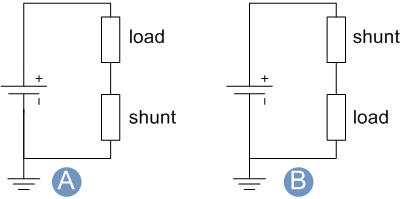
A diagram illustrating the basic principle of a shunt resistor in a circuit. Image Source: EEPower
When delving into the world of current measurement, you’ll often encounter two terms: shunt resistor and current sense resistor. Are they the same? For the most part, yes. The terms are often used interchangeably, as both components serve the same fundamental purpose: to measure current by creating a voltage drop across a known resistance. However, there are subtle contextual differences that are worth noting.
Generally, the term “shunt resistor” is used to describe larger, standalone resistors designed for high-current applications. Think of the robust, bolt-down shunts used in battery monitoring systems or ammeters, where they might be measuring hundreds of amps. On the other hand, “current sense resistor” often refers to smaller, surface-mount resistors that are integrated directly onto a printed circuit board (PCB) and paired with an amplifier. These are typically used for lower-current measurements within a specific electronic circuit.
Despite these contextual nuances, it’s crucial to understand that functionally, shunt resistors and current sense resistors are the same. They both operate on the same principle of Ohm’s Law and are selected based on similar criteria. Whether you’re choosing a large, off-board shunt or a tiny, on-board current sense resistor, the key considerations of resistance value, power rating, tolerance, and temperature coefficient remain paramount. So, while the terminology might vary depending on the application and physical form factor, the underlying engineering principles are identical.
Selecting the right shunt resistor is a critical step in designing an accurate and reliable current measurement system. It’s not just about picking a resistor with a low value; several key specifications must be carefully considered to ensure optimal performance. Let’s break down the most important factors to keep in mind.
The resistance value of a shunt resistor is typically very low, often in the milliohm (mΩ) or even microohm (µΩ) range. The goal is to choose a resistance that produces a measurable voltage drop at the desired current level without introducing significant power loss into the system. A higher resistance will generate a larger voltage signal, which is easier to measure, but it will also dissipate more power and potentially affect the circuit’s performance. It’s a trade-off that requires careful consideration of the specific application requirements.
The power rating of a shunt resistor is a critical safety consideration. It must be able to handle the maximum current that will flow through it without overheating or failing. The power dissipated by the resistor can be calculated using the formula P = I²·R. It’s essential to choose a resistor with a power rating that is significantly higher than the calculated maximum power dissipation, providing a safety margin to account for unexpected current spikes and to ensure long-term reliability. Derating the resistor, especially in high-temperature environments, is also a common practice.
The tolerance of a shunt resistor directly impacts the accuracy of the current measurement. For high-precision applications, such as in battery management systems or medical devices, a low tolerance (e.g., ±0.1% or better) is essential. A tighter tolerance ensures that the actual resistance value is very close to the nominal value, leading to more accurate and repeatable current measurements.
The temperature coefficient of resistance (TCR) is a measure of how much the resistance of the component changes with temperature. In automotive and power electronics applications, where operating temperatures can vary significantly, a low TCR is crucial. A resistor with a low TCR will maintain a stable resistance value across a wide temperature range, ensuring that the current measurement remains accurate even in harsh environments.
Shunt resistors are available in various form factors, from small surface-mount packages to large, bolt-down shunts. The choice of package depends on the current level, power dissipation, and mounting requirements of the application. For high-current applications, proper mounting and heat sinking are essential to dissipate the heat generated by the resistor and prevent it from overheating.
For applications involving fast-changing or AC currents, which are common in power electronics, the parasitic inductance of the shunt resistor can become a significant factor. A high parasitic inductance can introduce errors in the measurement at high frequencies. To minimize this effect, low-inductance designs, such as wide, flat resistors, are preferred.
For the highest precision requirements, 4-terminal shunt resistors, also known as Kelvin resistors, are the ideal choice. These resistors have two terminals for carrying the current and two separate terminals for sensing the voltage. This configuration eliminates the error introduced by the resistance of the leads and contacts, resulting in a much more accurate measurement, especially for very low resistance values.
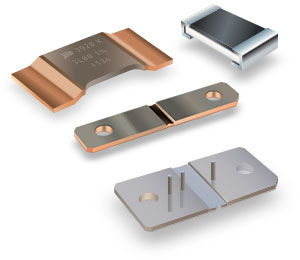
different types of shunt resistors, including surface-mount and bolt-down varieties. Image Source: Bourns
Once you understand the key specifications, the next step is to calculate the ideal resistance value and size the shunt resistor for your specific application. This involves a few straightforward calculations based on Ohm’s Law and the power formula.
The ideal resistance value for your shunt resistor can be calculated using Ohm’s Law: R = V/I. You’ll need to determine the desired full-scale current (I) you want to measure and the target voltage drop (V) across the resistor at that current. For example, if you want to measure a maximum current of 100A and you want a voltage drop of 50mV at that current, the required resistance would be R = 0.050V / 100A = 0.0005Ω or 500µΩ.
Choosing the right voltage drop is a balancing act. A higher voltage drop is easier to measure accurately, but it also means more power is being dissipated as heat, which can be a concern in battery-powered systems or high-efficiency designs. Common full-scale voltage drops are in the range of 50mV to 100mV, but the optimal value will depend on the specific requirements of your application.
After determining the resistance value, you need to calculate the power that the resistor will dissipate at the maximum current. This is done using the formula P = I²·R. Using our previous example, the power dissipation would be P = (100A)² * 0.0005Ω = 5W. To ensure the long-term reliability of the resistor, it’s crucial to select a component with a power rating that is significantly higher than this calculated value, typically at least double. So, in this case, you would choose a shunt resistor with a power rating of 10W or more.
Let’s walk through another example. Suppose you’re designing a current sensor for a 20A motor drive and you want a 100mV voltage drop at full current. The required resistance would be R = 0.100V / 20A = 0.005Ω or 5mΩ. The power dissipation would be P = (20A)² * 0.005Ω = 2W. Therefore, you would select a shunt resistor with a power rating of at least 4W.
Pro Tip: Many manufacturers provide online calculators and tools to assist in selecting the proper shunt value and rating based on your input requirements. These can be a valuable resource to simplify the selection process and ensure you’ve chosen the right component for your design.
In many modern electronic systems, particularly in the automotive and industrial sectors, high-precision current measurement is not just a desirable feature; it’s a critical requirement. In these applications, even the smallest inaccuracies can have significant consequences, affecting everything from battery life and motor efficiency to system safety and reliability. This is where high-precision shunt resistors and Kelvin connections come into play.
Consider a battery management system (BMS) in an electric vehicle. The BMS needs to accurately measure the current flowing into and out of the battery to calculate the state of charge (SOC) and state of health (SOH). An inaccurate current measurement can lead to an incorrect SOC estimation, which could result in the vehicle running out of power unexpectedly or, in a worst-case scenario, damage to the battery. Similarly, in a motor control system, precise current measurement is essential for optimizing motor performance and efficiency. In these and many other applications, the demand for high precision is driving the adoption of advanced shunt resistor technologies.
As we mentioned earlier, for the utmost precision, 4-wire Kelvin resistors are the gold standard. These resistors feature two large terminals for carrying the high current and two smaller, dedicated sense terminals for measuring the voltage drop. By separating the current path from the voltage measurement path, Kelvin connections effectively eliminate the influence of the lead and contact resistance, which can be a significant source of error, especially with very low resistance values. This results in a much more accurate and reliable measurement, making Kelvin resistors the preferred choice for high-precision applications.
High-precision shunt resistors are also characterized by their very low temperature coefficient of resistance (TCR) and excellent long-term stability. They are typically made from specialized alloys that exhibit minimal resistance change over a wide temperature range and over time. This ensures that the current measurement remains accurate and consistent, even in the harsh operating conditions often found in automotive and industrial environments.
Let’s revisit our automotive battery monitor example. To accurately track the charge and discharge currents, a 4-wire, 100µΩ shunt resistor might be used in conjunction with a high-precision instrumentation amplifier. The Kelvin connection ensures that the voltage measurement is not affected by the resistance of the high-current cables connecting the shunt to the battery. The low TCR of the shunt guarantees that the measurement remains accurate whether the vehicle is operating in the freezing temperatures of winter or the scorching heat of summer. This level of precision is essential for maximizing the performance, safety, and lifespan of the battery.
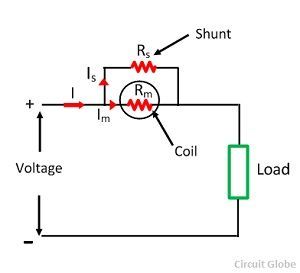
A diagram illustrating the 4-wire Kelvin connection for a shunt resistor. Image Source: Circuit Globe
The automotive industry is undergoing a massive transformation, with the rise of electric vehicles (EVs) and the increasing electrification of conventional vehicles. This has led to a surge in demand for high-performance shunt resistors for a wide range of applications. From battery management to powertrain control, these components are playing a crucial role in the safety, efficiency, and reliability of modern vehicles.
In electric and hybrid vehicles, the battery management system (BMS) is the brain of the battery pack. It’s responsible for monitoring the state of charge, state of health, and safety of the battery. A key component of the BMS is the current sensor, which is typically a high-power shunt resistor placed in series with the battery pack. By accurately measuring the current flowing into and out of the battery, the BMS can calculate the SOC, estimate the remaining range, and protect the battery from overcharging or over-discharging. The accuracy and reliability of the shunt resistor are paramount in this application, as they directly impact the performance and safety of the vehicle.
Even in conventional internal combustion engine (ICE) vehicles, shunt resistors are used in various powertrain systems. For example, they can be used to monitor the output of the alternator, measure the current drawn by the starter motor, or control the power delivered to various electronic modules. In EVs, shunt resistors are essential for sensing the current in the traction motor, which is used to control the vehicle’s speed and torque. The ability to accurately measure and control the motor current is critical for optimizing the vehicle’s performance, efficiency, and driving range.
Shunt resistors are also widely used in the on-board chargers (OBCs) and DC-DC converters of electric vehicles. In these applications, they provide feedback for current control and overload protection. By monitoring the charging current, the OBC can ensure that the battery is charged safely and efficiently. Shunt resistors also play a vital role in protecting the charging system from overcurrent conditions, which could damage the battery or other components.
The automotive environment is notoriously harsh, with wide temperature ranges, high levels of vibration, and stringent reliability requirements. Shunt resistors used in automotive applications must be designed to withstand these challenging conditions. They are often required to be AEC-Q200 qualified, which is a global standard for stress test qualification for passive electronic components in automotive applications. This ensures that the resistors can operate reliably over the lifetime of the vehicle.
Important Note: When selecting a shunt resistor for an automotive application, it’s crucial to choose a component that is AEC-Q200 qualified and comes from a reputable manufacturer. This will ensure that the resistor meets the high standards of quality and reliability required for the automotive industry.
Power electronics is another field where shunt resistors are indispensable. From renewable energy systems to industrial automation, these components are used to measure and control current in a wide variety of high-power applications. Their ability to provide accurate and reliable current feedback is essential for the efficient and safe operation of power electronic systems.
Shunt resistors are commonly used in AC/DC and DC/DC converters, which are the building blocks of many power electronic systems. These converters are used in a vast array of applications, including solar inverters, uninterruptible power supplies (UPS), and industrial power supplies. In these systems, shunt resistors are used to monitor the load current and implement control or protection functions, such as current limiting. By accurately measuring the current, the converter can regulate the output voltage or current, protect against overloads, and ensure the efficient transfer of power.
In motor drives and industrial automation equipment, precise current control is essential for achieving high performance and efficiency. Shunt resistors are used to measure the phase currents in motor controllers, providing feedback for the control algorithms. This allows the controller to precisely regulate the motor’s speed and torque, resulting in smooth and efficient operation. Shunt resistors are also used in robotic systems and other industrial equipment for precision current feedback, enabling precise control of actuators and other components.
Shunt-based current sensing is a common method for implementing overcurrent protection in electronic circuits, especially in DC systems. A microcontroller or a dedicated protection IC monitors the voltage across the shunt resistor. If the current exceeds a predetermined threshold, the controller can trip a circuit breaker or a fuse, protecting the circuit from damage. This is a simple yet effective way to provide robust overcurrent protection in a wide range of applications.
In heavy-duty applications, such as grid energy storage systems or large industrial power supplies, shunt resistors may need to measure currents of hundreds or even thousands of amps. These high-current shunts are typically robust, bolt-down components with very low resistance values. They often require careful consideration of thermal management, including the use of heat sinks or even active cooling, to dissipate the significant amount of heat they generate.
When measuring high voltages and currents, safety is a paramount concern. While the shunt resistor itself is a passive component, the measurement circuitry connected to it may need to be isolated from the high-voltage side of the circuit. This is often achieved using isolation amplifiers or specialized current sense modules. Ensuring proper isolation is critical for protecting personnel and downstream electronics from hazardous voltages.
While selecting the right shunt resistor is crucial, it’s only half the battle. To get an accurate and reliable current measurement, you also need to pay close attention to the design of the sensing circuit and be aware of potential sources of error. Here are some measurement techniques and troubleshooting tips to help you get the most out of your shunt resistor.
The voltage drop across a shunt resistor is typically very small, often in the millivolt range. To accurately measure this small signal, you’ll need a high-precision amplifier, such as a differential amplifier or an instrumentation amplifier. These amplifiers are designed to reject common-mode noise and provide a high-gain, low-noise output. It’s also important to filter the output of the amplifier to remove any unwanted noise and ensure a stable reading.
For high-precision applications, it’s often necessary to calibrate the measurement system. This involves accounting for the tolerance of the shunt resistor and any offset or gain errors in the amplifier. Calibration can be performed by applying a known current to the circuit and adjusting the measurement system to match the expected output. This ensures the highest level of accuracy and traceability.
There are several common issues that can affect the accuracy of a shunt-based current measurement. One of the most common is self-heating. As current flows through the shunt resistor, it generates heat, which can cause the resistance value to change, leading to measurement errors. Another common issue is additional resistance from connectors, PCB traces, and solder joints. In high-current applications, even a small amount of extra resistance can introduce significant errors. Finally, in high-EMI environments, such as inside a motor drive unit, the measurement signal can be susceptible to noise and interference.
Fortunately, there are several techniques you can use to mitigate these issues. To minimize the effects of self-heating, it’s important to choose a shunt resistor with a low TCR and to ensure proper heat sinking. To reduce the impact of additional resistance, use Kelvin connections whenever possible and ensure that all connections are tight and secure. For high-EMI environments, use shielded cables and proper filtering to protect the measurement signal from noise.
If you’re having trouble with your current measurement system, there are a few things you can check. First, visually inspect the shunt resistor for any signs of physical damage or overheating. Next, verify all connections and ensure they are tight and secure. Finally, use a known current source to test the accuracy of the measurement system. This will help you determine if the issue is with the shunt resistor, the amplifier, or some other part of the circuit.
With a wide variety of shunt resistors available on the market, choosing the right one for your application can be a daunting task. To make an informed decision, it’s essential to know how to read and interpret datasheets and to be aware of the differences between manufacturers.
The datasheet is your primary source of information about a shunt resistor. It contains all the key specifications you need to make an informed decision, including the resistance value, tolerance, TCR, power rating, maximum surge current, inductance, operating temperature range, and mounting type. It’s important to carefully review all of these parameters to ensure that the resistor meets the requirements of your application.
Different manufacturers specialize in different types of shunt resistors. Some focus on ultra-low resistance values for high-current applications, while others specialize in high-precision, low-TCR resistors for instrumentation and medical devices. Some of the leading manufacturers of shunt resistors include Vishay, Bourns, and Rohm. It’s always a good idea to compare the offerings from several different manufacturers to find the best component for your needs.

 Catalogue
 FPGA / CPLD
 Memory
 MOS
MOS  MCU
MCU  DSP
DSP OCEP
OCEP Secondary
  Other
Other 


