
075582814553

Are you wondering how much power an 8 AWG wire can handle, or whether you should choose copper or aluminum for your project? Understanding wire size is key to safe and efficient electrical design. In this article, we’ll break down the ampacity, uses, and NEC guidelines for #8 gauge wire so you can make the right choice with confidence.

Figure 1. 8 AWG Wire
The term #8 gauge refers to the American Wire Gauge (AWG) system, a standardized method for measuring the diameter of electrical conductors. In this system, the lower the gauge number, the thicker the wire. This means 8 AWG copper wire is significantly thicker than #10, #12, or #14 gauge wires, giving it a higher capacity to carry current safely.
Copper is widely used in electrical wiring because of its superior conductivity, resistance to corrosion, and long-term reliability. Its thicker cross-section allows 8 AWG copper to handle larger electrical loads without overheating or causing insulation damage.

Figure 2. 8 AWG Aluminum Wire
Aluminum is lighter and more affordable but has lower conductivity, so it carries less current for the same size. Ampacity depends on insulation type and installation:
• THHN/THWN-2, XHHW/XHHW-2, RHH/RHW-2, USE-2 → 45 amps
• RHW, THHW, XHHW → 40 amps
• TW/UF → 30 amps
• In conduit or raceway → 30–35 amps (THHN/THWN, XHHW) | 25–30 amps (UF)
• Subpanels and feeder lines: Often used to supply secondary breaker panels in garages, workshops, or additions.
• Air conditioning units and heat pumps: Provide sufficient current capacity for most mid-sized HVAC systems.
• Electric stoves, ovens, and water heaters: Safely deliver the higher power these appliances demand.
• Medium-load branch circuits: Common for equipment that requires more power than typical lighting or outlets.
• Motors and pumps: Suitable for machinery such as compressors, well pumps, and production equipment.
• Rugged portable cables for temporary power: Frequently used on construction sites or event setups where flexible but durable power distribution is required.
• Solar panel to inverter connections: Provides reliable current transfer between solar arrays and system inverters.
• Small wind turbine systems: Carry generated power efficiently to controllers and storage batteries.
• Agricultural irrigation pumps and farm equipment: Supports outdoor electrical loads where durability and current capacity are a must.

Figure 3. 8 AWG THHN/THWN-2 Copper
• 8 AWG THHN/THWN-2 Copper → 55 amps: Ideal for conduit installations in residential, commercial, or industrial settings. Its high conductivity and minimal voltage drop make it a top choice for heavy-duty circuits.
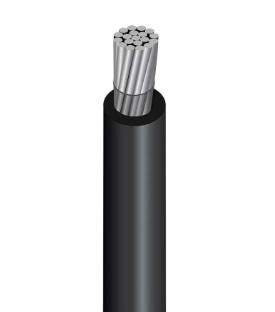
Figure 4. 8 AWG THHN/THWN-2 Aluminum
• 8 AWG THHN/THWN-2 Aluminum → 45 amps: A lighter, more affordable alternative to copper. Commonly used for feeders and longer runs where cost savings and reduced weight are important.

Figure 5. 8/2 & 8/3 NM-B Romex
• 8/2 & 8/3 NM-B Romex → 40 amps: A non-metallic sheathed cable is typically used indoors for branch circuits such as ranges, dryers, and water heaters. Flexible and easy to install, but not rated for outdoor or underground use.

Figure 6. 8/2 UF-B Cable
• 8/2 UF-B Cable → 40 amps: Built with a moisture-resistant jacket for direct burial or outdoor use. Commonly chosen for underground feeders to outbuildings, outdoor lighting, and pumps.

Figure 7. 8/3 Aluminum MC Cable
• 8/3 Aluminum MC Cable → 40–55 amps: A metal-clad armored cable that provides mechanical protection. Widely used in commercial and light industrial applications where durability and code compliance are critical.

Figure 8. 8-8-8-8 Aluminum SER Cable
• 8-8-8-8 Aluminum SER Cable → Up to 45 amps: A service entrance cable that typically contains four conductors. Frequently installed for subpanels, feeders, and service connections, offering a balance of cost-efficiency and reliability.
Voltage drop occurs when electricity loses pressure as it travels through a conductor, reducing efficiency and performance. While 8 AWG copper wire provides good current capacity, its effectiveness decreases over long distances if voltage drop is not managed.
• General Guideline: For a 240V circuit carrying around 40 amps, keep the run under 100 feet to maintain efficiency.
• Longer Runs: If the distance exceeds this, upgrading to 6 AWG or larger helps minimize losses and ensures stable operation.
Excessive voltage drop can lead to wasted energy, overheating, dimmed lighting, and reduced performance of sensitive equipment. Proper wire sizing during planning avoids these problems and ensures safe, reliable power delivery over the life of the installation.
| Wire Size | Ampacity (Approx.) | Typical Uses | Advantage |
| 6 AWG | 55–65 A | Heavy loads, long-distance runs | Reduces voltage drop |
| 8 AWG | 40–55 A | Stoves, A/C units, subpanels | Balanced choice |
| 10 AWG | 30–40 A | Small appliances, branch circuits | Affordable and common |
Choosing the right wire size isn’t just about following code; it’s about ensuring safety, efficiency, and long-term reliability. With its balance of capacity and versatility, 8 AWG wire is a trusted option for everything from home appliances to renewable energy systems. By considering material type, ampacity, installation methods, and voltage drop, you’ll be able to select and install 8 AWG wire properly for years of dependable performance.

 Catalogue
 FPGA / CPLD
 Memory
 MOS
MOS  MCU
MCU  DSP
DSP OCEP
OCEP Secondary
  Other
Other 


