
075582814553

This article explains the IRS2092 pin functions, internal working principle, main features, typical application circuit, alternatives, and common uses. It also compares the IRS2092 with other audio amplifier ICs to help you understand when this device is a better choice for high-power Class-D amplifier designs.
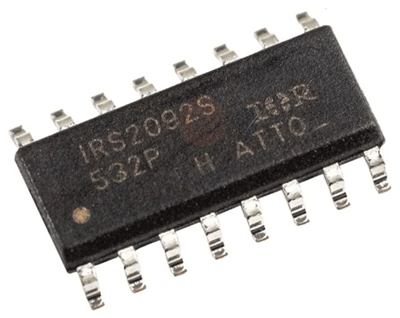
The IRS2092S
• TPA3255
• TPA3251
• TPA3116D2
• TAS5624A, etc.
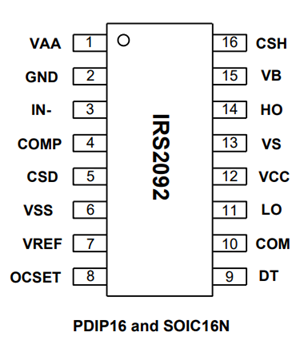
| Pin No. | Pin Name | Function |
| 1 | VAA | Analog supply voltage input for the internal analog control circuits. Provides power for signal processing sections of the IC. |
| 2 | GND | Ground reference for the analog circuitry. Serves as the return path for internal analog signals. |
| 3 | IN- | Inverting audio input. Receives the negative input signal for the amplifier's input stage. |
| 4 | COMP | Compensation pin used for loop stability and frequency compensation. External components may be connected to optimize amplifier performance. |
| 5 | CSD | Capacitor Soft-Start/Shutdown pin. Controls startup timing and helps reduce pop noise during power-up and shutdown. |
| 6 | VSS | Negative supply voltage or analog ground reference, depending on the application configuration. |
| 7 | VREF | Internal reference voltage output. Used as a stable voltage reference for external circuits and signal biasing. |
| 8 | OCSET | Overcurrent protection setting pin. An external resistor connected to this pin sets the overcurrent detection threshold. |
| 9 | DT | Dead-time control pin. Allows adjustment of switching dead time between the high-side and low-side MOSFET drivers to prevent shoot-through current. |
| 10 | COM | Power ground reference for the gate driver section. Acts as the return path for low-side gate drive currents. |
| 11 | LO | Low-side gate driver output. Drives the gate of the low-side external MOSFET. |
| 12 | VCC | Low-voltage supply input for the gate driver circuitry. Powers the low-side driver and internal logic. |
| 13 | VS | High-side floating return connection. Connected to the switching node between the high-side and low-side MOSFETs. |
| 14 | HO | High-side gate driver output. Drives the gate of the high-side external MOSFET. |
| 15 | VB | Floating bootstrap supply for the high-side driver. Typically connected to a bootstrap capacitor circuit. |
| 16 | CSH | Current-sense input. Used for current monitoring, overcurrent protection, and fault detection functions. |
The IRS2092 internal architecture combines audio processing, PWM generation, gate driving, and protection functions into a single IC. The audio signal enters the OTA (Operational Transconductance Amplifier), where it is compared with the feedback signal from the amplifier output. This comparison produces an error signal that helps maintain accurate audio reproduction and low distortion.
The error signal is sent to the comparator, which converts it into a Pulse Width Modulated (PWM) signal. The width of the PWM pulses changes according to the audio waveform, allowing the amplifier to represent the input signal using high-frequency switching.
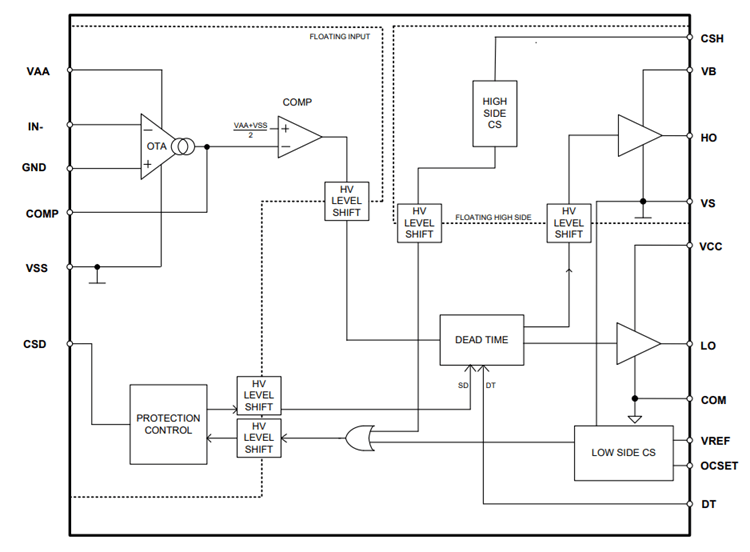
The PWM signal passes through high-voltage level shifters that transfer control signals from the low-voltage logic section to the floating high-side driver. A built-in dead-time circuit then inserts a short delay between the switching of the high-side and low-side MOSFETs to prevent shoot-through current and improve reliability.
The high-side and low-side gate drivers generate the HO and LO outputs that drive the external MOSFETs. These MOSFETs switch rapidly to produce a high-power PWM output waveform. After passing through an external LC filter, the PWM signal is converted back into an amplified audio signal.
To protect the amplifier, the IRS2092 includes high-side and low-side current-sensing circuits that continuously monitor the output stage. If an overload, short circuit, or excessive current condition is detected, the protection control block disables the gate drivers and shuts down the switching operation, helping prevent damage to the MOSFETs and speakers. This combination of PWM control, gate driving, dead-time management, and protection allows the IRS2092 to achieve high efficiency and low distortion in Class-D audio amplifier designs.
• Integrated Class-D audio amplifier driver with built-in PWM modulator
• Supports half-bridge MOSFET output stage design
• Floating input architecture for flexible circuit implementation
• Programmable bidirectional overcurrent protection (OCP)
• Automatic self-reset protection function
• Programmable dead-time control for improved audio performance
• Built-in shoot-through protection
• Start-up and shutdown click-noise reduction
• High noise immunity for stable operation in noisy environments
• High-side and low-side MOSFET gate drivers integrated into one IC
• ±100 V maximum voltage capability
• Supports amplifier output power up to 500 W
• Operates at switching frequencies up to 800 kHz
• Compatible with 3.3 V and 5 V logic inputs
• Integrated high-speed error amplifier (OTA)
• Under-voltage lockout (UVLO) protection for bias supplies
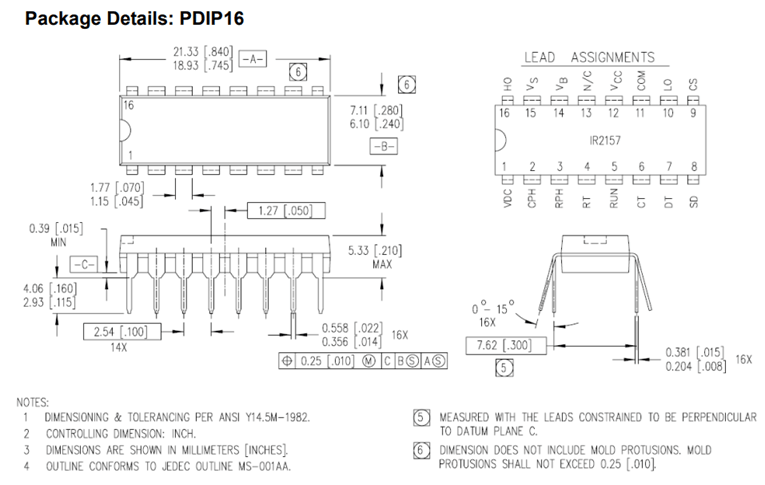
• Available in a compact 16-pin package
The typical IRS2092 connection diagram shows a complete half-bridge Class-D audio amplifier built around the IRS2092 controller IC, two external N-channel MOSFETs, and an LC output filter. The audio input signal enters the IN− pin through a coupling capacitor and resistor network. Inside the IC, the signal is processed by the error amplifier and PWM modulator, which convert the audio waveform into a high-frequency PWM signal.
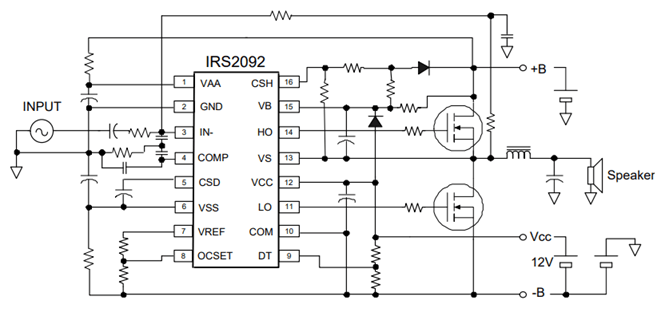
The HO and LO pins drive the gates of the upper and lower MOSFETs. These MOSFETs form the half-bridge output stage and switch alternately at high frequency. The VB, VS, and bootstrap diode-capacitor network provide the floating supply required for the high-side MOSFET driver. This allows the upper MOSFET to be driven even when its source voltage rises close to the positive supply rail.
The amplifier operates from a dual power supply, shown as +B and -B, which provides the high-voltage rails needed for audio output power. A separate 12 V supply connected to VCC powers the internal gate drivers. The OCSET, CSH, and VREF pins work with external resistors to configure the overcurrent protection system, allowing the IRS2092 to detect overloads and protect the MOSFETs and speaker from excessive current.
At the output stage, the switching waveform passes through an LC low-pass filter, consisting of an inductor and capacitor. This filter removes the high-frequency switching components and reconstructs the original audio waveform before it reaches the speaker. The result is a high-efficiency audio amplifier capable of delivering significant output power with low heat dissipation and low distortion.
| Feature | IRS2092 | TPA3255 | TDA7498 | TPA3116D2 |
| Amplifier Type | Class-D Controller + External MOSFETs | Integrated Class-D Amplifier | Integrated Class-D Amplifier | Integrated Class-D Amplifier |
| Typical Output Power | Up to 500W+ (depends on MOSFETs and supply) | Up to 315W Stereo / 600W Mono | Up to 2 × 100W | Up to 2 × 50W |
| Supply Voltage | Up to ±100V | 18V–53.5V | Up to 36V | 4.5V–26V |
| External MOSFETs Required | Yes | No | No | No |
| Design Complexity | High | Medium | Low | Very Low |
| Efficiency | >90% | >90% | >90% | >90% |
| Protection Features | OCP, UVLO, Dead-Time Control | OCP, OVP, UVLO, OTP | OCP, UVLO, Thermal Protection | OCP, UVLO, Thermal Protection |
| Flexibility | Very High | High | Medium | Medium |
| Best For | Professional Audio, High-Power Amplifiers | High-Fidelity Audio, Subwoofers | Home Audio Systems | Compact and Budget Amplifiers |
| Cost of Complete Design | Higher | Medium | Lower | Lowest |
The IRS2092 is used in professional power amplifiers for stage systems, concert equipment, and PA racks. It supports high-output Class-D designs because it can drive external MOSFETs and operate efficiently at high power levels.
The IRS2092 is suitable for active subwoofers that need strong low-frequency output. Its half-bridge driver structure allows the amplifier to handle high current when paired with proper MOSFETs, power supply rails, and output filtering.
The IRS2092 can be used in home theater amplifiers for subwoofer channels and high-power speaker outputs. Its Class-D operation helps reduce heat, which is useful in compact home audio equipment.
The IRS2092 is also used in Hi-Fi amplifier designs where efficiency and clean sound reproduction are important. With proper PCB layout, feedback design, and output filtering, it can deliver low-distortion audio performance.
Powered speakers use built-in amplifier circuits inside the speaker cabinet. The IRS2092 helps create compact amplifier modules because it combines PWM control, gate driving, dead-time control, and protection functions in one IC.
The IRS2092 can be used in guitar, bass, and keyboard amplifiers that need high output power with less weight. Class-D designs based on this IC are useful for portable amplifier systems used in live performance.
The IRS2092 is suitable for car audio amplifiers, especially for subwoofer and high-power speaker channels. Its efficient switching operation helps reduce heat buildup in the limited space of vehicle audio installations.
The IRS2092 is popular in DIY and custom amplifier builds because it gives designers flexibility in MOSFET selection, supply voltage, output power, and protection settings. This makes it useful for custom audio boards and experimental Class-D amplifier projects.
Infineon Technologies has strong manufacturing capability for the IRS2092 because it is a major global semiconductor company with deep experience in power ICs, gate drivers, and power management devices. The IRS2092 also benefits from Infineon’s International Rectifier technology background, which is well known in MOSFET drivers and Class-D amplifier solutions. With advanced chip design, wafer production, testing, and quality control, Infineon can support reliable production of IRS2092 devices for high-performance audio amplifier designs.

 Catalogue
 FPGA / CPLD
 Memory
 MOS
MOS  MCU
MCU  DSP
DSP OCEP
OCEP Secondary
  Other
Other 


