
075582814553

RFID helps businesses identify, count, and monitor items without checking each object manually. Although RFID may sound complex, the basic idea is simple. RFID readers use antennas to communicate with tags attached to items such as clothes, tools, equipment, cables, packages, and shipping containers. This article explains the main types of RFID systems, key technical specifications, recognized standards, common applications, and more.
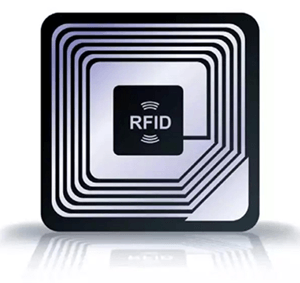
Radio Frequency Identification (RFID) is a wireless technology used to identify, track, and manage objects, products, assets, animals, or people using radio waves. Unlike traditional barcodes, RFID does not require direct line-of-sight scanning. This means an RFID system can read tag information automatically from a short or long distance, depending on the RFID frequency, tag type, reader power, and environment.
Based on the RFID system shown in the image, the main components are the RFID tag, reader antenna, RFID reader, host computer, application software, and database. These parts work together to collect, process, manage, and store identification data.
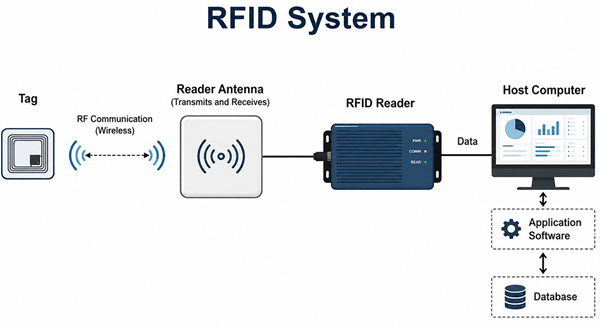
RFID works by using radio waves to exchange data between an RFID tag and an RFID reader without physical contact.
First, an RFID tag is attached to an item, product, or asset. The tag contains a microchip that stores a unique identification number or other data.
When the item enters the reading area, the reader antenna sends out radio frequency signals. In a passive RFID system, these signals provide the energy needed to activate the RFID tag. Once activated, the tag transmits its stored information back to the antenna.
The antenna receives the tag's response and sends it to the RFID reader. The reader decodes the radio signal and converts it into digital data that a computer can understand.
The decoded information is then sent to the application software, which processes the data and checks the associated records. Finally, the information is stored in a database, where it can be used for inventory management, asset tracking, access control, and reporting.
RFID systems can be classified based on their operating frequency and power source. Different RFID technologies offer different reading ranges, data transfer speeds, and application capabilities.
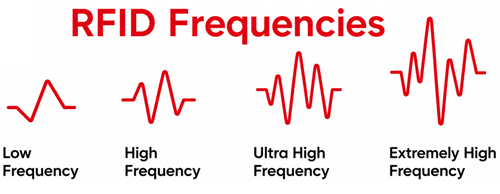
LF RFID operates between 30 kHz and 300 kHz, with 125 kHz and 134.2 kHz being the most widely used frequencies. These systems typically provide a read range of up to 10 cm, although some specialized systems can reach up to 1 meter. LF RFID performs well around metal, water, dirt, and other challenging materials. Common applications include animal identification, access control systems, vehicle immobilizers, and livestock tracking.
HF RFID operates between 3 MHz and 30 MHz, with 13.56 MHz serving as the international standard frequency. Typical read ranges vary from 10 cm to 1 meter, depending on antenna size and reader power. HF RFID supports faster data transfer than LF RFID and is commonly used in contactless payment cards, public transportation tickets, library management systems, smart cards, and NFC-enabled devices.
UHF RFID operates between 300 MHz and 3 GHz, although most commercial RFID systems use frequencies between 860 MHz and 960 MHz. Passive UHF RFID systems typically provide read ranges of 3 to 12 meters, while specialized systems may achieve even greater distances. UHF RFID offers high reading speeds and can identify hundreds of tags within seconds, making it widely used in warehouse management, retail inventory tracking, logistics, supply chain operations, and asset management.
EHF RFID, often called microwave RFID, operates above 3 GHz, with common RFID implementations using 2.45 GHz and 5.8 GHz microwave frequencies. These systems can support read ranges of up to 10 meters or more and provide very high data transfer rates. EHF RFID is commonly used in electronic toll collection systems, transportation monitoring, industrial automation, container tracking, and specialized real-time location systems. However, microwave signals are more sensitive to obstacles, moisture, and environmental interference than lower-frequency RFID technologies.
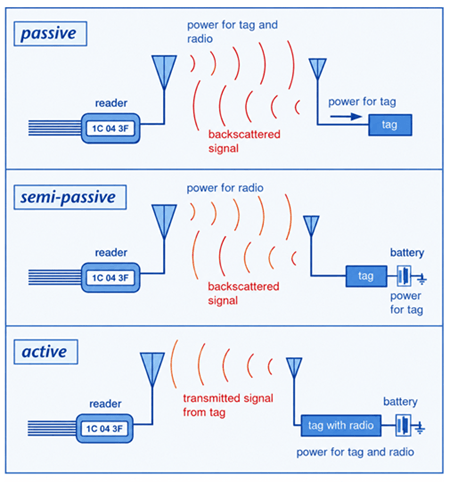
RFID systems can also be classified according to how the tag is powered. Passive RFID tags do not contain a battery and receive energy from the reader's radio signal. They are low-cost, compact, and commonly used for inventory and asset tracking. Active RFID tags contain an internal battery that continuously powers the tag, enabling longer reading ranges and real-time tracking of high-value assets. Semi-passive RFID tags, also called battery-assisted passive tags, use a battery to power the microchip while relying on the reader's signal for communication. They provide better performance and sensitivity than passive tags while consuming less power than active tags.
The operating frequency determines how RFID tags and readers communicate. RFID systems are commonly classified as LF (125–134.2 kHz), HF (13.56 MHz), and UHF (860–960 MHz). Higher frequencies generally provide faster data transfer and longer reading distances, while lower frequencies offer better performance around metal and liquids.
Read range refers to the maximum distance at which an RFID reader can successfully communicate with a tag. The actual range depends on the RFID frequency, tag design, reader power, antenna type, and surrounding environment. LF RFID typically works within a few centimeters, HF RFID can reach about 1 meter, and UHF RFID may operate over several meters.
RFID tags contain memory that stores identification data and other information. Memory capacity varies by tag type, ranging from simple tags that store only a unique identifier to advanced tags capable of storing product details, maintenance records, and sensor data.
Data transfer speed indicates how quickly information can be exchanged between the RFID tag and reader. Higher-frequency RFID systems generally support faster communication and can read multiple tags simultaneously, which is especially useful in inventory management and logistics operations.
RFID systems use passive, active, and semi-passive tags. Passive tags operate without a battery and receive power from the reader signal. Active tags use an internal battery to achieve longer reading distances, while semi-passive tags combine battery-assisted operation with reader-based communication.
Many RFID tags are designed to operate in challenging environments. Depending on the construction and enclosure, RFID tags can resist moisture, dust, vibration, chemicals, and extreme temperatures. Specialized industrial tags are available for outdoor, medical, and manufacturing applications.
Anti-collision technology allows an RFID reader to identify multiple tags within the same reading area without signal interference. This feature significantly improves efficiency in warehouses, retail stores, and supply chain systems where large numbers of tagged items must be scanned quickly.
Following recognized standards allows RFID systems to operate consistently across various industries and regions.
• ISO 18000 Series – International standards that define air interface protocols for different RFID frequency ranges, including LF, HF, and UHF RFID systems.
• ISO 14443 – For short-range contactless smart cards and identification systems, commonly used in payment cards, access control, and public transportation.
• ISO 15693 – A standard for vicinity cards that supports longer reading distances than ISO 14443 and is widely used in asset tracking, libraries, and inventory management.
• EPC Gen2 (EPCglobal Class 1 Gen 2) – Defines how RFID tags and readers communicate and supports fast multi-tag reading in supply chain and retail applications.
• GS1 EPC Standards – Standards developed by GS1 that enable unique product identification and tracking throughout the global supply chain using Electronic Product Codes (EPC).
• ISO/IEC 29167 – A family of RFID security standards that adds authentication and cryptographic features to improve data protection and prevent unauthorized access.
• NFC Standards (ISO 18092 and ISO 21481) – Standards used for Near Field Communication (NFC). Enabling secure short-range communication for mobile payments, smart devices, and data exchange.
• RAIN RFID Standards – Industry standards based on UHF RFID technology that support item-level identification, inventory visibility, and real-time asset tracking across large-scale operations.
| Advantages | Limitations |
| Does not require direct line-of-sight scanning. | Higher implementation cost than barcode systems. |
| Can read multiple tags simultaneously. | Performance can be affected by metal surfaces and liquids. |
| Enables fast and automated data collection. | Active RFID tags require battery maintenance and replacement. |
| Supports real-time tracking of assets and inventory. | RFID infrastructure may require specialized readers and software. |
| Reduces manual labor and human errors. | Unauthorized reading may create privacy or security concerns if not properly protected. |
| Provides accurate inventory and asset management. | Read range and performance can vary depending on frequency and environment. |
| Tags can store more data than traditional barcodes. | System setup and integration can be complex for large deployments. |
| RFID tags can be durable and operate in harsh environments. | Some RFID tags are more expensive than printed barcode labels. |
| Improves supply chain visibility and operational efficiency. | Regulatory frequency requirements may differ between countries. |
| Supports contactless identification and tracking. | Initial deployment costs can be significant for small businesses. |
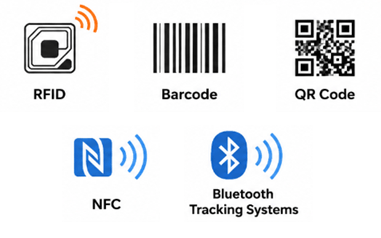
RFID and barcode systems work in different ways. A barcode must be scanned using light, so the scanner needs a clear line of sight to the printed label. RFID uses radio waves, so the tag can be read without direct visual contact. RFID can also read multiple tags at the same time, while barcode scanning usually reads one label at a time. However, barcode systems are cheaper and easier to install, making them suitable for basic product labeling and retail checkout.
QR codes require a camera or scanner to capture the printed code. This means the QR code must be visible and clean enough to scan. RFID tags do not need to be visible because they communicate through radio signals. RFID is better for automated tracking, inventory control, and warehouse operations. QR codes are better for low-cost uses such as product information, website links, mobile payments, and customer engagement.
NFC is a type of short-range wireless communication based on high-frequency RFID technology. Both RFID and NFC can transfer data without physical contact, but NFC usually works only within a very short range, often a few centimeters. RFID can work over short or long distances depending on the frequency and tag type. RFID is commonly used for inventory tracking, logistics, access control, and asset management. NFC is more common in mobile payments, smart cards, ticketing, and smartphone-based authentication.
RFID is often used to identify items at specific checkpoints, such as warehouse doors, storage shelves, or checkout areas. Passive RFID tags do not need batteries, which makes them practical for tracking large numbers of items. Bluetooth tracking systems use battery-powered devices and are better for real-time location tracking over longer distances. However, Bluetooth tags are usually more expensive and require battery maintenance.
RFID technology is used across many industries to automate identification, improve visibility, and reduce manual processes.
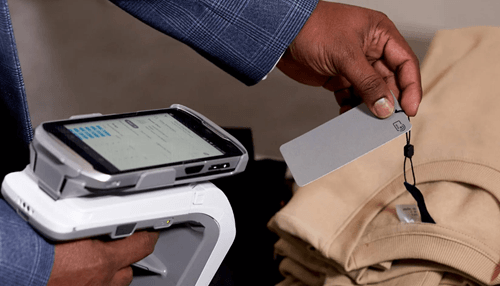
RFID helps businesses maintain accurate inventory records by automatically identifying products stored in warehouses, distribution centers, and retail locations. Multiple items can be scanned simultaneously, reducing manual counting and improving stock visibility.
Organizations use RFID to monitor valuable assets such as computers, tools, machinery, laboratory equipment, and office furniture. RFID helps locate assets quickly, prevent loss, and simplify equipment audits.
RFID provides visibility throughout the movement of goods from manufacturers to distributors and retailers. Companies can monitor shipments, verify deliveries, and improve operational efficiency by tracking products at different stages of the supply chain.
Retail stores use RFID to improve product availability, support self-checkout systems, reduce theft, and streamline stock replenishment. RFID also helps retailers understand product movement within stores.
RFID cards, badges, and key fobs are commonly used to control access to offices, buildings, parking areas, and restricted facilities. The technology provides fast and convenient user authentication without requiring physical keys.
RFID technology is widely used in contactless payment cards and electronic fare systems. Users can complete transactions quickly by tapping a card or device near a compatible reader.
Hospitals use RFID to identify patients, manage medical equipment, track medications, and monitor surgical instruments. This helps improve patient safety and reduces the risk of misplaced assets.
RFID tags are used to identify pets, cattle, sheep, and other livestock. The technology helps track ownership, vaccination records, breeding history, and animal movement.
Many transportation systems use RFID for automatic toll collection. Vehicles equipped with RFID tags can pass through toll points without stopping, improving traffic flow and reducing congestion.
Libraries and archives use RFID to manage books, files, and documents. RFID simplifies borrowing, returns, inventory checks, and anti-theft monitoring.
Manufacturers use RFID to track materials, components, and products during production. This improves traceability, quality control, and workflow management.
Airports and airlines use RFID to identify and route luggage throughout the baggage handling process. This improves tracking accuracy and helps reduce lost or delayed baggage.
RFID performance can be affected by several factors.
Metal objects and liquids can interfere with radio signals, reducing reading accuracy and range.
Proper tag placement is also important, as tags mounted too close to metal surfaces or positioned incorrectly may be difficult to detect.
The reader's power output and antenna design influence the reading distance and coverage area. Higher power and properly positioned antennas generally provide better performance.
Environmental conditions such as extreme temperatures, moisture, dust, and electromagnetic interference can also affect RFID reliability.
RFID systems can improve efficiency and automation, but they also introduce security and privacy concerns. Because RFID tags communicate wirelessly, unauthorized readers may attempt to access tag information if proper security measures are not in place.
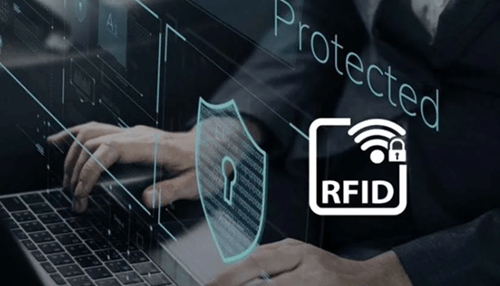
To reduce security risks, many RFID systems use authentication, encryption, password protection, and access control mechanisms. These features help prevent unauthorized reading, data modification, and cloning of RFID tags.
Privacy is another important consideration, especially when RFID is used for personal identification, access cards, payment systems, or consumer products. Organizations should ensure that RFID data is collected, stored, and used according to applicable privacy regulations and security policies.
Regular system monitoring, secure database management, and proper reader configuration can further improve RFID security and help protect sensitive information from unauthorized access.
RFID technology is becoming more advanced, affordable, and widely adopted across industries. One major trend is its integration with IoT platforms, allowing real-time tracking and monitoring of assets and inventory. RFID is also being combined with AI and data analytics to improve forecasting, automation, and operational efficiency. At the same time, newer RFID tags are becoming smaller, more durable, and better suited for challenging environments. As security technologies improve and costs continue to decrease, RFID is expected to play a larger role in smart factories, smart warehouses, healthcare systems, and other connected environments.

 Catalogue
 FPGA / CPLD
 Memory
 MOS
MOS  MCU
MCU  DSP
DSP OCEP
OCEP Secondary
  Other
Other 


