
075582814553

Diodes are the building blocks of modern electronics, known for their ability to control the direction of current flow. This article explores the working principles, types, applications, testing methods, and packaging options of diodes to help you understand their importance in today’s electronic systems.
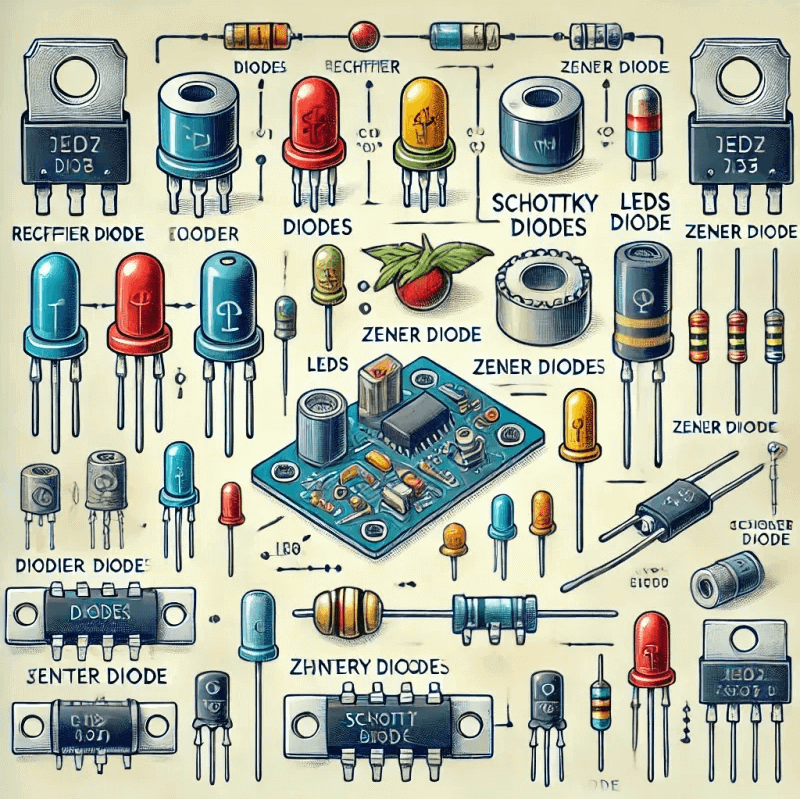
Figure 1. Diodes
A diode is a two-terminal semiconductor device that allows current to flow in only one direction, from anode to cathode, while blocking it in the opposite direction. At the center of a diode is a p-n junction, which conducts when forward-biased and blocks current when reverse-biased.
Diodes come in many types, including Zener, Schottky, and LEDs, each suited for specific tasks.
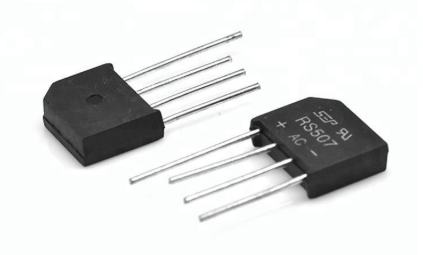
Figure 2. Rectifier Diodes
Rectifier Diodes: These diodes convert AC to DC, making them useful in power supply circuits. A half-wave rectifier uses one diode to pass only the positive half of an AC signal, while full-wave bridge rectifiers use four diodes to convert both halves, improving efficiency.
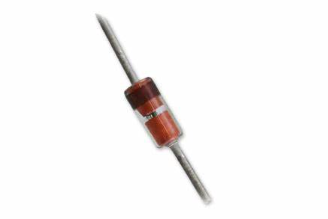
Figure 3. Zener Diodes
Zener Diodes: Zener diodes operate in reverse breakdown mode to maintain a consistent voltage. They're ideal for voltage regulation, protecting components from voltage spikes and ensuring stability under fluctuating loads.
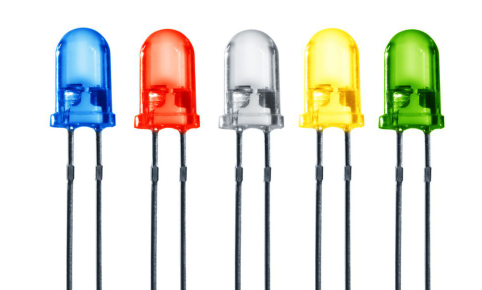
Figure 4. Light-Emitting Diodes
Light-Emitting Diodes (LEDs): LEDs emit light when forward-biased. The color depends on the semiconductor material. Their high efficiency, small size, and long lifespan make them standard in lighting, indicators, displays, and optical communication.
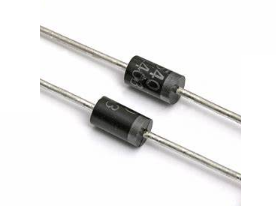
Figure 5. Schottky Diodes
Schottky Diodes: Built with a metal-semiconductor junction, Schottky diodes offer low forward voltage drop and fast switching. They're used in high-efficiency circuits like power converters, RF systems, and solar inverters.
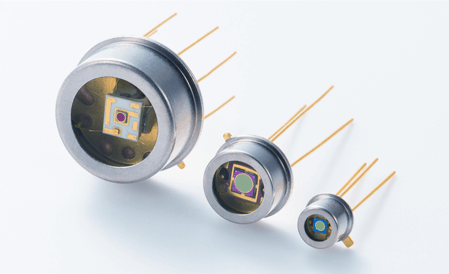
Figure 6. Photodiodes
Photodiodes: Photodiodes convert light into electrical current, with output proportional to light intensity. They're widely used in optical communication, light sensors, and imaging systems.
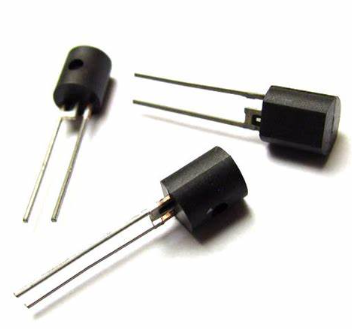
Figure 7. Varactor Diodes
Varactor Diodes: Also called varicap diodes, these function as voltage-controlled capacitors. Their capacitance varies with reverse voltage, making them useful in RF tuning, phase-locked loops, and frequency modulation.
• Power Conversion: Rectifier diodes convert alternating current (AC) to direct current (DC), making them needed in power supplies for consumer electronics, industrial equipment, and automotive systems. Schottky diodes, known for their low forward voltage drop and fast switching speed, enhance efficiency in switch-mode power supplies (SMPS). Zener diodes are widely used for voltage regulation, ensuring stable output in both linear regulators and switching regulators.
• Signal Processing: In analog circuits, diodes are useful in shaping and conditioning signals. Clipping diodes limit signal voltage to protect downstream circuits, while clamping diodes shift waveform baselines. These functions are used in analog TV systems, audio electronics, and RF signal mixers. Voltage multipliers, used in devices requiring high voltage from a low-voltage source, also rely on diode networks to step up voltage levels efficiently.
• Circuit Protection: Flyback diodes (also called freewheeling diodes) prevent voltage spikes across inductive loads like relays, solenoids, and motors when switching off. Zener diodes are used to clamp overvoltage conditions, protecting low-voltage ICs. Transient Voltage Suppression (TVS) diodes absorb high-energy surges from lightning, electrostatic discharge (ESD), or power transients, making them common in USB ports, data lines, and automotive circuits.
• RF and Microwave Systems: Specialized diodes serve serious roles in radio-frequency (RF) and microwave communication systems. Schottky diodes are preferred for their high-speed switching in RF mixers and detectors. PIN diodes, with their variable resistance properties under bias, function as RF switches and attenuators. Varactor diodes, which vary capacitance with voltage, enable electronic tuning in voltage-controlled oscillators (VCOs), filters, and phase-locked loops (PLLs).
• Optical Systems: Light-emitting diodes (LEDs) and photodiodes are central to optical communication and sensing. LEDs provide efficient, long-lasting light sources for displays, indicators, and infrared transmitters. Photodiodes detect light levels in devices such as cameras, remote controls, and safety sensors. In fiber optic systems, laser diodes and photodiodes are key components for high-speed data transmission and reception.
• Computing and Logic: While modern computing circuits primarily rely on transistors, diodes still provide support functions. Schottky diodes are integrated into high-speed logic families to reduce switching delays and power loss. Diodes also serve as ESD protection elements in ICs, safeguarding delicate inputs. Additionally, they help route power correctly in multi-voltage systems, such as USB-powered microcontroller boards and battery-charging circuits.
Testing a diode helps determine if it functions correctly, allowing current to flow in one direction while blocking it in the other. The most common tool for this is a digital multimeter, but understanding a diode's current-voltage (IV) characteristics can also aid in deeper analysis.
To test a diode with a multimeter, follow these steps:
• Step 1: Set the Multimeter to Diode Mode
Most digital multimeters have a dedicated diode test mode, usually indicated by a diode symbol (►|–). This mode applies a small voltage across the diode and measures the voltage drop.
• Step 2: Perform the Forward Bias Test
Connect the red (positive) probe to the anode and the black (negative) probe to the cathode. A good silicon diode should display a forward voltage drop of approximately 0.6 to 0.7 volts. For Schottky diodes, this value is lower, typically around 0.2 to 0.4 volts, due to their metal-semiconductor junction.
• Step 3: Perform the Reverse Bias Test
Reverse the probe connections: red to cathode and black to anode. A healthy diode should not conduct in this configuration. The meter will typically display “OL” (over limit), indicating open circuit or no conduction, as expected in reverse bias. If the diode shows a voltage drop in both directions or “0.00” in either direction, it's likely shorted or damaged. If it always shows “OL,” it may be open and non-functional.
The IV (current-voltage) curve visually represents how a diode conducts under different voltage conditions:
• Forward Region: The curve remains flat until the threshold or knee voltage is reached (typically 0.6–0.7V for silicon diodes). Beyond this point, current increases rapidly with a small increase in voltage, this is normal conduction in forward bias.
• Reverse Region: In reverse bias, current remains negligible across a wide voltage range.
Once the breakdown voltage is reached (only in special diodes like Zeners), current begins to flow in reverse. For Zener diodes, this reverse conduction is intentional and stable, making them ideal for voltage regulation.
• Through-Hole Packages: Common types like DO-41 and DO-35 are ideal for prototyping and educational projects. Their long leads make manual insertion and soldering easy, offering durability for testing and debugging.
• Surface-Mount Devices (SMD): Compact and efficient for automated assembly, SMD packages like SOD-123 and SOD-323 are standard in modern electronics. They save space and perform reliably in high-density circuit boards.
• Bolt-Mount Packages: High-power diodes such as those in TO-64 and TO-208 packages are bolted to heat sinks for thermal management. These are used in heavy-duty applications, including aerospace, industrial drives, and military-grade equipment.
Whether you're designing a power supply, protecting sensitive components, or working with optical and RF systems, diodes play an irreplaceable role in ensuring functionality and efficiency. By understanding the characteristics and applications of various diode types and knowing how to test and select the right one, you can build more reliable and effective electronic designs.

 Catalogue
 FPGA / CPLD
 Memory
 MOS
MOS  MCU
MCU  DSP
DSP OCEP
OCEP Secondary
  Other
Other 


