
075582814553

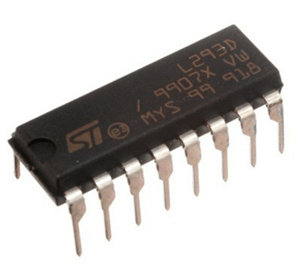
Controlling a motor with a microcontroller is not as simple as connecting it directly to an output pin. Most microcontrollers cannot provide enough current to drive motors safely, and attempting to do so may damage the circuit. The L293D is one of the most widely used motor driver ICs use in this situation. In this article, you will learn what the L293D is, how it works internally, its key specifications, pin functions, Arduino interfacing process, and more.
The L298N
| DRV8833 | <a href="https://www.y-ic.com/pdf/Cypress-Semiconductor-Infineon-Technologies/bts7960.html" target="_blank" "="" style="cursor: pointer; color: rgb(0, 0, 238);">BTS7960 | ||||
| Driver Type | Dual H-Bridge | Dual H-Bridge | Dual H-Bridge | Dual H-Bridge | Full H-Bridge |
| Motor Supply Voltage | 4.5 V to 36 V | 5 V to 46 V | 4.5 V to 13.5 V | 2.7 V to 10.8 V | 5.5 V to 27 V |
| Logic Voltage | 4.5 V to 7 V | 5 V | 2.7 V to 5.5 V | 2 V to 7 V | 3.3 V to 5 V |
| Continuous Output Current | 600 mA/channel | 2 A/channel | 1.2 A/channel | 1.5 A/channel | 43 A |
| Peak Output Current | 1.2 A/channel | 3 A/channel | 3.2 A/channel | 2 A/channel | 55 A |
| Internal Protection Diodes | Yes | No | Yes | Yes | Yes |
| Thermal Protection | Yes | Yes | Yes | Yes | Yes |
| PWM Support | Yes | Yes | Yes | Yes | Yes |
| Output Technology | Bipolar Transistors | Bipolar Transistors | MOSFET | MOSFET | MOSFET |
| Efficiency | Low | Low | High | High | Very High |
| Voltage Drop | High (≈1.2–1.8 V per side) | High (≈2–4 V total) | Low (<0.5 V typical) | Low (<0.4 V typical) | Very Low |
| Heat Generation | High | High | Low | Low | Low |
| External Heatsink Required | Usually Not | Often Required | Rarely Required | Rarely Required | Required at High Current |
| Number of DC Motors | 2 | 2 | 2 | 2 | 1 High-Power Motor |
| Best For | Small DC Motors, Education Projects | Medium-Power Motors | Robots, Battery Devices | Compact Portable Designs | High-Power Motors and Robotics |
The L293D is widely used in educational projects and Arduino-based learning platforms. Its simple interface allows beginners to control DC motors and learn basic concepts such as motor direction control, PWM speed control, and H-bridge operation without requiring complex circuitry.
Many small robotic vehicles use the L293D to drive two DC motors independently. This allows the robot to move forward, reverse, turn left, and turn right by controlling the direction and speed of each motor separately.
The dual H-bridge architecture of the L293D can be used to control bipolar stepper motors. By energizing the motor coils in a specific sequence, the driver enables precise step-by-step movement for positioning applications.
The L293D can drive relays and solenoids that require more current than a microcontroller output pin can provide. Its built-in protection diodes help suppress voltage spikes generated when these inductive loads are switched.
In simple automation systems, the L293D is used to control small actuators, valves, and mechanical devices. The driver provides an easy way to interface logic circuits with electromechanical loads.

STMicroelectronics is one of the world's leading semiconductor manufacturers, with decades of experience in designing and producing analog, power management, motor control, and mixed-signal integrated circuits. For products such as the L293D motor driver IC, STMicroelectronics uses mature semiconductor manufacturing processes to ensure consistent electrical performance, reliability, thermal stability, and long-term product availability. Its manufacturing capabilities are supported by extensive research and development resources, automated production systems, and compliance with international quality and environmental standards.

 Catalogue
 FPGA / CPLD
 Memory
 MOS
MOS  MCU
MCU  DSP
DSP OCEP
OCEP Secondary
  Other
Other 


