
075582814553

The ICL7107 ADC with Display Driver is a practical IC for building simple and accurate digital measurement displays. It combines a 3½-digit analog-to-digital converter, LED display driver, reference, clock, and decoder in one package, which helps reduce circuit complexity. Instead of using a separate ADC, microcontroller, and display driver, the ICL7107 can directly convert an analog voltage and show the result on a seven-segment LED display.
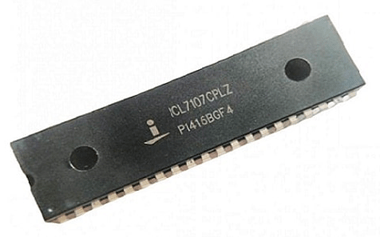
The ICL7107 is a high-performance, low-power 3½-digit A/D converter with a built-in seven-segment decoder, display driver, reference, and clock. It is designed to directly drive instrument-size LED displays, making it a practical solution for digital measurement designs. It offers high accuracy, auto-zero correction below 10 µV, low drift under 1 µV/°C, input bias current of 10 pA maximum, and rollover error below one count. Its true differential input and reference help improve measurement stability and reduce common signal errors.
• CA3162E
• <a href="https://www.y-ic.com/search.htm?keywords=CA3161E" target="_blank" "="" style="cursor: pointer; color: rgb(0, 0, 238); font-weight: bold;">CA3161E

| Pin No. | Pin Name | Description |
| 1 | V+ | Positive power supply input for the IC. |
| 2 | D1 | Drives segment D of the units digit display. |
| 3 | C1 | Drives segment C of the units digit display. |
| 4 | B1 | Drives segment B of the units digit display. |
| 5 | A1 | Drives segment A of the units digit display. |
| 6 | F1 | Drives segment F of the units digit display. |
| 7 | G1 | Drives segment G of the units digit display. |
| 8 | E1 | Drives segment E of the units digit display. |
| 9 | D2 | Drives segment D of the tens digit display. |
| 10 | C2 | Drives segment C of the tens digit display. |
| 11 | B2 | Drives segment B of the tens digit display. |
| 12 | A2 | Drives segment A of the tens digit display. |
| 13 | F2 | Drives segment F of the tens digit display. |
| 14 | E2 | Drives segment E of the tens digit display. |
| 15 | D3 | Drives segment D of the hundreds digit display. |
| 16 | B3 | Drives segment B of the hundreds digit display. |
| 17 | F3 | Drives segment F of the hundreds digit display. |
| 18 | E3 | Drives segment E of the hundreds digit display. |
| 19 | AB4 | Drives the most significant digit (1 or minus sign). |
| 20 | POL | Polarity output used to indicate negative measurements. |
| 21 | BP/GND | LED display return or ground connection. |
| 22 | G3 | Drives segment G of the hundreds digit display. |
| 23 | A3 | Drives segment A of the hundreds digit display. |
| 24 | C3 | Drives segment C of the hundreds digit display. |
| 25 | G2 (10's) | Drives segment G of the tens digit display. |
| 26 | V− | Negative power supply input. |
| 27 | INT | Integrator output used in the dual-slope conversion process. |
| 28 | BUFF | Internal buffer amplifier output. |
| 29 | A-Z | Auto-zero capacitor connection. |
| 30 | IN LO | Low-side analog input. |
| 31 | IN HI | High-side analog input. |
| 32 | COMMON | Analog common reference point. |
| 33 | CREF− | Negative reference capacitor terminal. |
| 34 | CREF+ | Positive reference capacitor terminal. |
| 35 | REF LO | Low reference voltage input. |
| 36 | REF HI | High reference voltage input. |
| 37 | TEST | Test pin used for display testing and diagnostics. |
| 38 | OSC 3 | Oscillator connection for clock generation. |
| 39 | OSC 2 | Oscillator connection for clock generation. |
| 40 | OSC 1 | Oscillator connection for clock generation. |
| Category | Specification |
| Device Type | 3½-Digit Analog-to-Digital Converter (ADC) with Integrated LED Display Driver |
| ADC Resolution | 2000 counts (3½ digits) |
| Display Interface | Direct LED seven-segment display drive |
| Display Capability | ±1999 count display range |
| Conversion Method | Dual-Slope Integration ADC |
| Auto-Zero Performance | Guaranteed zero reading for 0 V input on all scales |
| Zero Drift | Less than 1 µV/°C |
| Input Offset Voltage | Auto-zero to less than 10 µV |
| Input Bias Current | 1 pA typical, 10 pA maximum |
| Input Configuration | True differential input |
| Reference Configuration | True differential reference |
| Input Noise | Typically less than 15 µV peak-to-peak |
| Polarity Detection | True polarity indication at zero crossing |
| Reference Source | On-chip reference |
| Clock Source | On-chip clock with external oscillator adjustment |
| Oscillator Pins | OSC1, OSC2, OSC3 |
| Display Driver | Integrated seven-segment decoder and LED driver |
| Additional Active Components Required | None |
| Display Stability | Enhanced display stability with auto-zero operation |
| Power Dissipation | Typically less than 10 mW |
| Supply Voltage (V+ to V−) | Up to 15 V |
| Supply Voltage (V+ to GND) | Up to 6 V |
| Supply Voltage (V− to GND) | Down to −9 V |
| Analog Input Voltage Range | V+ to V− |
| Reference Input Voltage Range | V+ to V− |
| Operating Display Type | Instrument-size LED display |
| Calibration Support | External reference adjustment available |
| Test Function | Dedicated TEST pin for display verification |
| Package Options | PDIP, MQFP |
| Thermal Resistance (PDIP) | 50 °C/W (Typical) |
| Thermal Resistance (MQFP) | 75 °C/W (Typical) |
| Maximum Junction Temperature | +150 °C |
| Storage Temperature Range | −65 °C to +150 °C |
| RoHS Compliance | Pb-Free (RoHS Compliant) |
The circuit shown above demonstrates a typical digital panel meter design based on the ICL7107. This integrated circuit combines a 3½-digit analog-to-digital converter and a direct LED display driver, allowing a measured analog voltage to be converted and displayed without requiring a separate microcontroller or display controller. The circuit is configured for a full-scale measurement range of 200 mV, making it suitable for precision voltage measurement applications.
The input signal is applied to the IN HI and IN LO pins of the ICL7107. The converter continuously compares the input voltage against an internal reference voltage generated through the REF HI and REF LO pins. The accuracy of the displayed reading depends heavily on the stability of this reference voltage. In this circuit, resistors and capacitors connected to the reference pins help establish a stable measurement baseline and improve reading consistency.
Several external capacitors are used to support the ICL7107's dual-slope conversion process. The auto-zero capacitor, reference capacitor, and integrator capacitor work together to minimize offset errors, reduce noise, and improve measurement accuracy. This dual-slope conversion technique provides excellent noise rejection, particularly against power-line interference, which helps maintain stable and reliable readings.

The oscillator network formed by resistor R3 and capacitor C4 determines the conversion timing of the ADC. The oscillator controls how quickly the converter performs measurement cycles and updates the display. Proper oscillator component values are important because they directly affect conversion speed and display stability.
The LED display connects directly to the segment driver outputs of the ICL7107. Unlike many ADCs that require additional display-driving circuitry, the ICL7107 can drive instrument-size seven-segment LED displays directly. The IC automatically decodes the measured value and updates the display, reducing component count and simplifying circuit design.
To measure voltages greater than 200 mV, additional input scaling components such as resistor divider networks must be added to the input stage. This allows the panel meter to display higher voltage ranges while keeping the ADC input within its specified measurement limits. Careful calibration of the reference voltage and input scaling network ensures accurate readings across the selected measurement range.

This circuit shows how the ICL7107 can be used to generate overrange (O/RANGE) and underrange (U/RANGE) signals when the measured input voltage exceeds or falls below the selected measurement range. These signals help external control systems identify when a reading is outside the valid display range.
The circuit monitors specific display outputs from the ICL7107 and processes them through an LM339 comparator and logic gates. When the measured value exceeds the maximum displayable count, the overrange output becomes active. Likewise, when the input falls below the measurable range, the underrange output is triggered.
This feature is useful for adding range monitoring, warning indicators, or automatic range-switching functions to digital measurement systems. It allows the ICL7107 to provide not only a numeric display but also status signals that indicate whether the measurement remains within the desired operating range.
The ICL7107 is mainly used in digital voltmeters because it can convert analog voltage into a clear 3½-digit LED reading with only a few external components.
The ICL7107 can measure current indirectly by reading the small voltage across a shunt resistor. This makes it useful for current displays in power and charging equipment.
The IC is suitable for compact panel meters where a simple numeric display is needed for voltage, current, temperature, pressure, or other converted sensor signals.
In adjustable or regulated power supplies, the ICL7107 can show output voltage or current directly on an LED display, helping users check settings quickly.
The device can be used to display battery voltage, making it easier to monitor charge condition in chargers, backup systems, and portable equipment.
The ICL7107 can display scaled analog signals from sensors or control circuits, especially when a basic but stable local readout is needed.
| Feature | ICL7107 | ICL7106 |
| Display Type | LED Display | LCD Display |
| Display Driver | Integrated LED Driver | Integrated LCD Driver |
| Power Consumption | Higher due to LED display current | Very low due to LCD operation |
| Supply Requirement | Typically requires dual supply operation | Can operate from a single 9V battery |
| Display Brightness | Bright and easy to read in low-light conditions | Depends on ambient light or backlight |
| Viewing Distance | Better for long-distance viewing | Better for close-range viewing |
| Battery-Powered Applications | Less suitable because of higher power consumption | Highly suitable because of low power consumption |
| External Display Driver Needed | No | No |
| ADC Resolution | 3½ Digits (2000 Counts) | 3½ Digits (2000 Counts) |
| Conversion Method | Dual-Slope ADC | Dual-Slope ADC |
| Auto-Zero Function | Yes | Yes |
| Differential Input | Yes | Yes |
| Differential Reference | Yes | Yes |
| Measurement Accuracy | High | High |
| Typical Instrument Type | LED Panel Meters | LCD Panel Meters |
| Best For | Industrial displays and visible panel meters | Portable and battery-operated instruments |
| Main Advantage | Direct LED drive with excellent visibility | Extremely low power consumption |
| Main Limitation | Higher power consumption | LCD visibility may be limited in poor lighting |
| Feature | ICL7107 | Modern Microcontroller ADC Solutions |
| Device Type | Dedicated ADC with LED Display Driver | Microcontroller with Integrated ADC |
| ADC Resolution | 3½ Digits (2000 Counts) | Typically 10-bit to 16-bit or higher |
| Display Support | Direct LED Display Drive | Requires external display interface or software control |
| Programming Required | No | Yes |
| Circuit Complexity | Simple | Moderate to High |
| Component Count | Low | Higher depending on the display and peripherals |
| Measurement Flexibility | Fixed measurement functions | Highly configurable through firmware |
| Data Processing | Limited to measurement display | Advanced processing, filtering, and calculations |
| Communication Interfaces | None | UART, I²C, SPI, USB, CAN, Ethernet, and more |
| Data Logging Capability | No | Yes |
| Wireless Connectivity | No | Available through Wi-Fi, Bluetooth, LoRa, etc. |
| Calibration Options | Hardware-based | Hardware and software-based |
| User Interface Options | LED Display Only | LCD, OLED, TFT, touchscreen, web interface, and more |
| Measurement Accuracy | Good for basic measurement tasks | Depends on ADC quality and system design |
| Update and Customization | Hardware modifications required | Firmware updates can add new features |
| Development Time | Faster for simple meters | Longer due to software development |
| Cost for Simple Meter | Lower | Usually higher |
| Power Consumption | Moderate due to LED display | Varies depending on the microcontroller and display |
| Best Use Case | Simple digital panel meters and voltmeters | Smart measurement, monitoring, and connected devices |

The ICL7107 combines ADC conversion and LED display driving in one IC. It simplifies the design process, reduces the need for extra display components, and provides stable 3½-digit readings when the circuit is properly calibrated. However, the ICL7107 is best suited for simple display-based measurement systems. If a project needs data logging, wireless communication, software processing, or advanced user interfaces, a modern microcontroller-based ADC may be a better option.

 Catalogue
 FPGA / CPLD
 Memory
 MOS
MOS  MCU
MCU  DSP
DSP OCEP
OCEP Secondary
  Other
Other 


