
075582814553

Read-Only Memory (ROM) is a basic component in digital enabling devices to reliably start, operate, and retain serious instructions even when powered off. Unlike volatile memory such as RAM, ROM is designed for permanence and data integrity, making it requisite in embedded systems, consumer electronics, computers, and industrial controls. This article explores ROM's definition, internal structure, types, key characteristics, advantages, limitations, applications, and the promising future of non-volatile memory alternatives.

Figure 1. Read-Only Memory (ROM)
Read-Only Memory (ROM) is a non-volatile memory that stores data permanently, even when power is off. It is mainly used to hold firmware, dangerous software that starts hardware, and manages boot-up. Unlike RAM, ROM retains its data during reboots and power loss, making it active for embedded systems, computers, and consumer electronics.
Originally, ROM was fixed during manufacturing (Mask ROM) and couldn't be modified. Over time, more flexible types emerged, including PROM, EPROM, EEPROM, and Flash, allowing data to be programmed and reprogrammed as needed. These advancements transformed ROM from a static storage medium into a dynamic, upgradable solution used in modern systems requiring both stability and flexibility.

Figure 2. Construction of ROM
Read-Only Memory (ROM) is designed for permanent or semi-permanent data retention. Structurally, it consists of a grid-like matrix with horizontal word lines and vertical bit lines, where each intersection forms a memory cell that stores a binary value (‘1’ or ‘0’). These cells are built using diodes or transistors, depending on the ROM type. To access data, a device sends a binary address to the ROM's address decoder, which activates the corresponding word line. This, in turn, allows the values stored in the memory cells along that row to be transmitted via bit lines, amplified by sense amplifiers, and then delivered to the output buffers.
Functionally, ROM is optimized for fast and predictable read access, useful for storing firmware, boot loaders, and other low-level code required for hardware initialization. Once programmed, either during manufacturing (as in Mask ROM) or through user-accessible methods (like PROM, EPROM, or EEPROM), its contents remain fixed.
Unlike RAM or flash memory, ROM is not intended for frequent modification, which protects it from corruption due to software errors, power failures, or malicious tampering. This design ensures serious routines remain intact across system reboots or power loss.
ROM comes in several variations, each designed to meet different design and application requirements.

Figure 3. Mask ROM
• Mask ROM is the original, non-programmable form of ROM. The data is permanently embedded into the chip during manufacturing using a photolithographic process. Because it cannot be modified afterward, it's ideal for high-volume production where firmware never changes, such as in simple consumer electronics.

Figure 4. PROM (Programmable ROM)
• PROM (Programmable ROM) offers a bit more flexibility. It is manufactured as a blank chip and can be programmed once by using a special device that sends high-voltage pulses. However, once programmed, the data cannot be altered or erased, making PROM suitable for situations where code is finalized after manufacturing.

Figure 5. EPROM (Erasable Programmable ROM)
• EPROM (Erasable Programmable ROM) improves on PROM by allowing data to be erased and rewritten. Erasure is done by exposing the chip to ultraviolet (UV) light through a transparent quartz window on the chip package. After erasure, the memory can be reprogrammed electrically. This type is useful in development stages but requires physical removal from the system for erasure, which is time-consuming.

Figure 6. EEPROM (Electrically Erasable Programmable ROM)
• EEPROM (Electrically Erasable Programmable ROM) removes the need for UV light by enabling electrical erasure and rewriting. It allows data to be erased and written at the byte level without removing the chip from the circuit. EEPROM is commonly used in systems where settings or small amounts of data need to be updated occasionally, such as in BIOS chips or smart cards.
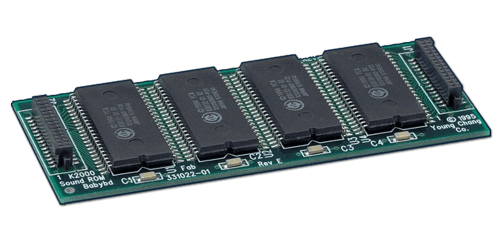
Figure 7. Flash ROM
• Flash ROM is a modern evolution of EEPROM. It allows faster write and erase operations by handling data in blocks rather than individual bytes. This makes it ideal for storing large amounts of data or firmware, and it's widely used in USB drives, SSDs, smartphones, and embedded systems. It combines speed, reliability, and non-volatility, making it the most popular ROM type in modern electronics.
| Characteristic | Description |
| Non-volatility | ROM retains stored data even when the power supply is removed. This makes it ideal for storing firmware or system boot code that must persist through reboots or power loss. |
| Fast Read Speeds | ROM is optimized for high-speed data access. Once the address is decoded, the corresponding data can be read almost instantly, enabling quick system startup and consistent performance. |
| Data Integrity | ROM types are generally read-only or have controlled write mechanisms, which helps prevent accidental data corruption or modification, dangerous for storing stable firmware and hardware instructions. |
| Low Power Consumption | ROM uses less power compared to RAM, especially during read operations. This makes it well-suited for battery-powered and embedded devices where energy efficiency is key. |
| Limited Write Capabilities | Traditional ROM is not writable, and even reprogrammable types like EEPROM and Flash allow only a finite number of write/erase cycles. This limits their use in applications requiring frequent data updates. |
| Slower Write Speeds (in reprogrammable ROM) | While read speeds are fast, EEPROM and Flash ROM typically have slower write operations compared to RAM. This is due to the more complex processes involved in erasing and rewriting data. |
• Reprogramming Is Slower and Limited: Unlike RAM or Flash-based storage, ROM types that support reprogramming (like EPROM, EEPROM, and Flash) require more time to erase and rewrite data. This can be a bottleneck in systems needing frequent updates.
• Permanently Programmed Variants Can't Be Altered: Mask ROM is programmed during fabrication and cannot be changed afterward. If bugs or updates are needed, the entire chip must be redesigned and remanufactured, making it inflexible for evolving systems.
• Limited Write/Erase Cycles: Reprogrammable ROM types such as EEPROM and Flash have a finite number of write and erase cycles, typically ranging from 10,000 to 1,000,000 cycles. Over time, this wear can degrade the memory’s reliability in write-intensive applications.
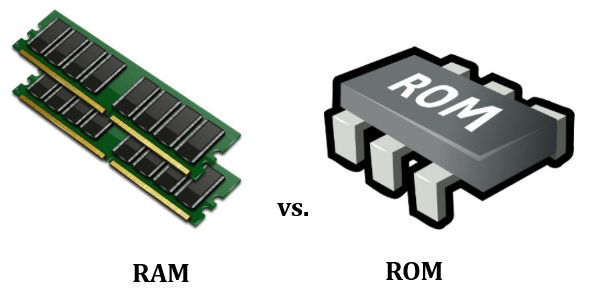
Figure 8. RAM vs. ROM
| Feature | ROM (Read-Only Memory) | RAM (Random Access Memory) |
| Volatility | Non-volatile – retains data even when power is off | Volatile – data is lost when power is turned off |
| Data Access | Typically, read-only in normal operation | Read and write operations are both supported |
| Speed | Fast read speeds; write speeds (if allowed) are slower | High-speed read and write performance |
| Purpose | Stores permanent instructions like firmware and boot loaders | Stores temporary data and instructions for active processing |
| Reprogrammability | Limited or not possible (depends on type: Mask ROM, PROM, etc.) | Freely writable and erasable during runtime |
| Data Retention Use Case | Ideal for storing needs, unchanging system software | Used for dynamic data that changes during system operation |
| Lifespan of Data | Data is retained permanently (or until reprogrammed) | Data exists only during system operation |
| System Role | Ensures system startup and basic hardware operation | Handles multitasking, running applications, and user data |
| Feature | ROM (Read-Only Memory) | Hard Drive (HDD/SSD) |
| Type | Non-volatile memory chip | Non-volatile mass storage device |
| Purpose | Stores firmware or low-level system software | Stores operating system, programs, files, and user data |
| Volatility | Non-volatile (data retained without power) | Non-volatile (data retained without power) |
| Modifiability | Usually not user-modifiable (except Flash, EEPROM types) | Fully user-writable and rewritable |
| Speed | Very fast read speed for boot operations | Slower than ROM (HDDs especially), but SSDs are much faster |
| Storage Capacity | Very small (KB to MB range) | Very large (GBs to several TBs) |
| Form Factor | Embedded on the motherboard or chip-level | External/internal drive with disk or flash memory |
| Function During Boot | Provides essential instructions for hardware initialization | Loads the operating system after initial ROM execution |
| Data Type Stored | Fixed instructions or firmware | Dynamic files, documents, software, OS, and user data |
| Example Use | BIOS/UEFI, embedded system boot code | Saving files, installing applications, storing media |
Flash memory continues to dominate modern ROM applications due to its versatility, fast block-level access, and high storage density. Its ability to be electrically erased and reprogrammed makes it ideal for embedded systems, firmware updates, and portable devices. Ongoing innovations, such as 3D NAND architecture, wear leveling algorithms, and advanced error correction codes (ECC), are extending flash memory’s lifespan, reliability, and storage capacity, ensuring it remains the backbone of non-volatile memory solutions for the foreseeable future.
However, as devices demand faster performance, lower power consumption, and greater write endurance, emerging non-volatile memory technologies are gaining attention:
• MRAM (Magnetoresistive RAM): MRAM stores data using magnetic states rather than electrical charges. It offers near-SRAM speeds with non-volatility, excellent endurance, and instant-on performance, making it a potential candidate for both cache and persistent memory in embedded and industrial applications.
• ReRAM (Resistive RAM): ReRAM works by changing the resistance across a dielectric solid-state material. It promises high speed, low power operation, and simple structure, allowing for dense and scalable memory architectures ideal for AI edge devices and IoT nodes.
• FRAM (Ferroelectric RAM): FRAM combines fast access with low power consumption and near-infinite write cycles. Though limited in density compared to flash, it is increasingly adopted in low-power, mission-critical applications such as medical and automotive systems.
• PCM (Phase Change Memory): PCM uses heat-induced changes in a material’s phase to represent binary data. It delivers high endurance and scalability and is being considered for next-generation storage-class memory, bridging the gap between DRAM and NAND flash.
As these alternatives mature, they may gradually replace traditional ROM and flash in specific use cases, mostly where speed, endurance, or energy efficiency is serious. In the coming years, the shift toward universal memory technologies could unify the roles of RAM and ROM, streamlining system design and performance.
From early hardwired Mask ROMs to modern Flash and emerging technologies like MRAM and ReRAM, ROM has continually adapted to meet the growing demands of electronic systems. Its ability to preserve data without power, support secure firmware storage, and deliver fast, predictable reads has cemented its role in nearly every digital device. As new memory innovations offer faster speeds, improved endurance, and energy efficiency, ROM's role is set to evolve further, blurring the lines between traditional memory categories and enabling smarter, more adaptable devices. Understanding ROM's capabilities and limitations is useful for selecting the right memory solution for both current and next-generation applications.

 Catalogue
 FPGA / CPLD
 Memory
 MOS
MOS  MCU
MCU  DSP
DSP OCEP
OCEP Secondary
  Other
Other 


