
075582814553

This article provides a comprehensive overview of both passive and active components, explains how they interact within circuits, and explores their applications across various industries. It also highlights emerging technologies that are shaping the future of electronic hardware.
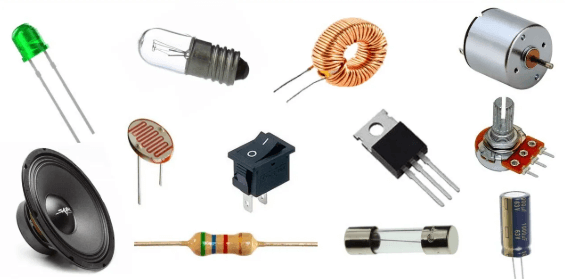
Figure 1. Electronic Component
An electronic component is a discrete physical device used in electronic circuits to control, influence, or manage the flow of electrical energy or signals. Electronic components are categorized based on how they interact with electrical signals and power within a circuit. The two primary classifications are passive components and active components.
Passive components do not amplify signals but instead influence voltage, current, and signal timing by providing impedance, energy storage, or filtering capabilities. Common types of passive components include RESISTORS, CAPACITORS, and inductors.
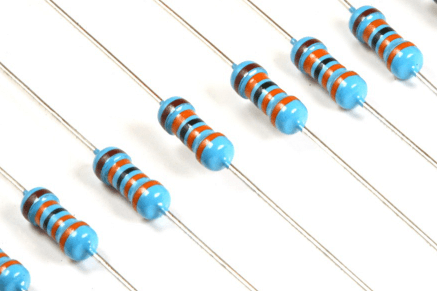
Figure 2. Resistor
Governed by Ohm’s Law (V = I × R), resistors are used in voltage division, current limiting, signal attenuation. Types of resistors include fixed resistors, which maintain a constant resistance value, and variable resistors (potentiometers), which allow for adjustable resistance. Resistors are available in through-hole and surface-mount forms, often marked with color bands for easy value identification.
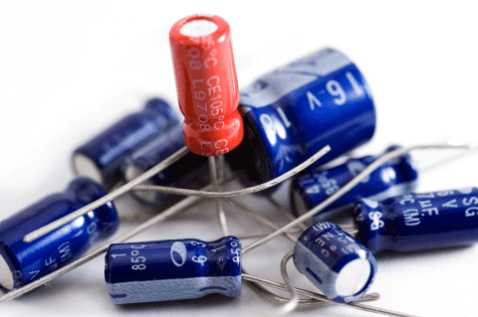
Figure 3. Capacitors
Capacitance is determined by the plate area, separation distance, and dielectric material. Common capacitor types include ceramic, electrolytic, film, and tantalum.
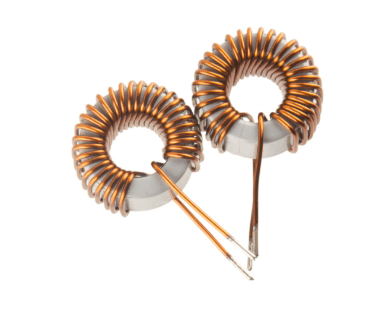
Figure 4. Inductors
Inductors are categorized by their core materials, such as air-core, iron-core, or ferrite-core, which influence their frequency characteristics.
Active components use an external power source to amplify, modulate, or switch electrical signals. These elements are basic in modern electronics for logic control and signal processing.
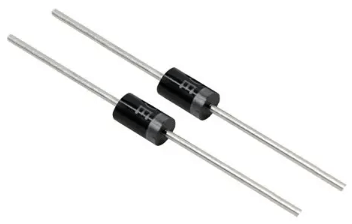
Figure 5. DIODES
Based on a P-N junction,diodes conduct in forward bias and block current in reverse bias. Variants include Zener, Schottky, Light Emitting Diodes (LEDs), and photodiodes.
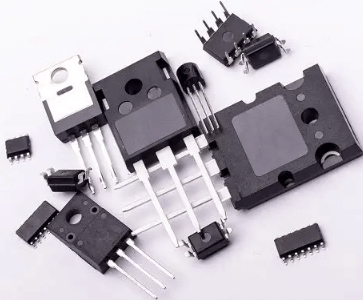
Figure 6. Transistors
Common types include Bipolar Junction Transistors (BJTs) and Metal-Oxide-Semiconductor Field-Effect Transistors (MOSFETs). Transistors are needed in integrated circuits and processor designs due to their scalability and versatility.

Figure 7. Integrated Circuits (ICs)
An Integrated Circuit offers high performance, compact size, and energy efficiency, enabling the miniaturization of complex systems.
• RESISTORS: Resistors limit current flow and convert electrical energy into heat. They are useful for voltage division, current limiting, and biasing in electronic circuits.
• CAPACITORS: Capacitors store and release electrical charge. They are commonly used for filtering, coupling/decoupling signals, and stabilizing voltage in power supplies.
• Inductors: Inductors oppose sudden changes in current by generating a magnetic field. They are key components in filters, energy storage (in power converters), and radio-frequency applications.
• Transformers: Transformers transfer electrical energy between circuits through electromagnetic induction. They are primarily used to convert AC voltage levels while maintaining electrical isolation.
• DIODES: Diodes allow current to flow in only one direction, acting as one-way valves.
• Transistors: Transistors use a small input current or voltage to control a larger output current. They are widely used in amplification, signal modulation, and switching applications.
• Integrated Circuits (ICs): ICs combine multiple electronic components, such as transistors, resistors, and capacitors, into a single chip. They serve various functions, including processing, memory storage, signal control, and system management.
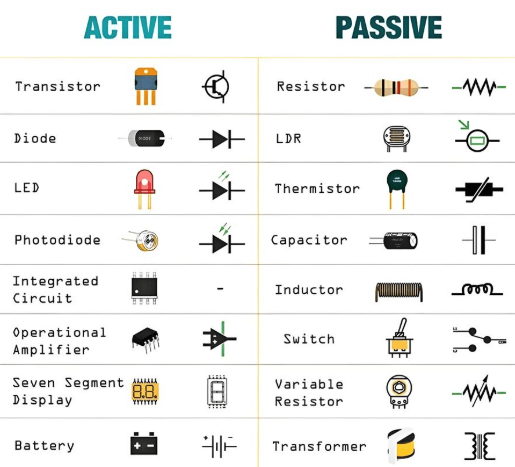
| Component | Function |
| Resistor | Controls current flow, divides voltage |
| Capacitor | Stores energy, filters signals |
| Inductor | Filters current, stores magnetic energy |
| Diode | Directs current flow, rectifies AC |
| Transistor | Amplifies or switches signals |
| IC | Performs computation and signal processing |
| Switch | Opens/closes electrical connections |
| Component | Advantages | Disadvantages |
| Resistor | Inexpensive, reliable | Generates heat, no energy storage |
| Capacitor | Filters noise, stabilizes voltage | Limited capacity, leakage potential |
| Inductor | Good for filtering and energy storage | Bulky, can produce voltage spikes |
| Transformer | Voltage conversion, galvanic isolation | Heavy, AC-only operation |
| Transistor | High efficiency, compact | Sensitive to thermal and bias issues |
| IC | Highly functional, space-saving | Difficult to modify or repair |
| Diode | Simple and effective current control | Only conducts in one direction |
Proper identification and testing of electronic components are used for troubleshooting, circuit design, repairs, and ensuring overall system reliability. Whether you're working with passive or active components, the ability to recognize and verify their functionality is a basic skill in electronics.
Understanding how to visually and contextually identify electronic components helps in determining their specifications and ensuring correct placement in a circuit. Common identification techniques include:
• Markings and Part Numbers: Most components, especially ICs, transistors, and DIODES, are labeled with part numbers and codes. These can be cross-referenced with datasheets to find pin configurations, electrical characteristics, and package types.
• Color Codes (Common in RESISTORS and Inductors): Through-hole resistors and some inductors use color bands to indicate resistance, tolerance, and sometimes temperature coefficient. Learning to decode these is needed for quick identification without measurement tools.
• Standard Circuit Symbols: Schematic diagrams use standardized symbols to represent components such as CAPACITORS, resistors, diodes, transistors, and ICs. Understanding these symbols helps in circuit analysis and identifying the components they represent on physical boards.
Testing verifies whether a component is functional and meets its specified parameters. The right tools allow accurate measurements and help detect faulty parts before installation.
• Multimeter: A versatile tool that measures voltage, current, resistance, diode drop, and continuity. It’s commonly used to check resistors, diodes, and continuity across connections. Advanced digital multimeters may also test transistors and capacitors.
• LCR Meter or Component Tester: These instruments measure L (inductance), C (capacitance), and R (resistance) with greater precision. Some advanced testers can also evaluate transistor gain (hFE), ESR (Equivalent Series Resistance) in capacitors, and identify component type automatically.
• Oscilloscope: Useful for analyzing the behavior of components immediately by visualizing voltage waveforms. It helps assess frequency response, signal integrity, rise/fall times, and identify anomalies in active components or signal paths.
To ensure the safety, reliability, and performance of your electronic circuits, it’s required to avoid several frequent errors that can lead to malfunction or even permanent damage. Below are some of the most common pitfalls and how to prevent them:
• Incorrect Polarity: Components like DIODES, LEDs, and electrolytic CAPACITORS are polarized, meaning they must be connected in a specific direction. Reversing polarity can prevent the component from working, cause it to overheat, or, in extreme cases, lead to physical damage (e.g., a capacitor bursting). Always double-check polarity markings before soldering or powering the circuit.
• Overvoltage or Overcurrent Exposure: Supplying a voltage or current beyond a component’s rated limits can lead to irreversible damage. For example, applying excessive voltage to an LED without a current-limiting resistor can burn it out instantly. Similarly, transistors and ICs may overheat or fail if exposed to currents they aren’t designed to handle. Always consult datasheets and use protective components such as RESISTORS, fuses, or current limiters.
• Wrong Component Values: Using resistors, capacitors, or inductors with incorrect values can significantly affect timing circuits, filters, or voltage dividers. For example, the wrong resistor in a biasing network can shift an amplifier’s operating point, while an incorrect capacitor value may change an oscillator’s frequency. Use proper labeling, color-code interpretation, or a multimeter to verify values before installation.
• Poor Soldering Techniques: Cold solder joints, excessive solder blobs, or weak connections can result in unreliable performance, intermittent faults, or open circuits. Good solder joints should be shiny, smooth, and properly bonded to both the component lead and PCB pad. Always use a clean, temperature-controlled soldering iron and practice proper soldering techniques.
• Inadequate Cooling or Heat Dissipation: Components such as voltage regulators, power transistors, and high-power resistors can generate significant heat during operation. Without proper heat sinks, airflow, or thermal pads, these components may degrade over time or shut down due to thermal protection. Ensure proper thermal management by checking thermal resistance values and designing with ventilation or heat dissipation in mind.
The field of electronic components continues to evolve rapidly, driven by advances in materials science, miniaturization, and the increasing demands of modern applications such as IoT, AI, renewable energy, and wearable electronics. Below are some of the most prominent emerging technologies shaping the future of electronic components:
• Wide Bandgap Semiconductors (SiC & GaN)
Silicon Carbide (SiC) and Gallium Nitride (GaN) components are revolutionizing power electronics due to their ability to operate at higher voltages, frequencies, and temperatures than traditional silicon-based devices. These materials enable more efficient power conversion in electric vehicles, solar inverters, and high-frequency applications.
• Flexible and Printed Electronics
Flexible components built on substrates like plastic, paper, or textile are enabling bendable, stretchable, and even wearable electronics. Printed electronics, made using conductive inks and roll-to-roll processing, reduce production costs and allow integration into non-traditional surfaces for applications in smart packaging, e-textiles, and healthcare.
• MEMS and NEMS Devices
Microelectromechanical systems (MEMS) and nanoelectromechanical systems (NEMS) integrate mechanical elements with electronics on a micro- or nano-scale. They are useful for sensors (like accelerometers, gyroscopes, and pressure sensors), RF components, and biomedical devices due to their compact size and low power consumption.
• Photonic and Optoelectronic Components
As data rates soar, photonic components, like silicon photonics and optoelectronic ICs, are gaining ground. These devices use light to transmit signals, offering higher bandwidth and lower latency. Applications include high-speed internet, LiDAR systems, and advanced imaging technologies.
• Quantum Electronic Components
Though still largely experimental, quantum-based components such as qubits, Josephson junctions, and quantum dots promise to redefine computation and sensing. These components exploit quantum mechanical phenomena to achieve processing speeds and data security beyond classical limitations.
• Advanced Passive Components
RESISTORS, CAPACITORS, and inductors are also evolving. Innovations like multilayer ceramic capacitors (MLCCs) with higher capacitance in smaller sizes and integrated passive devices (IPDs) are supporting compact, high-performance circuit designs, especially in RF and mobile technologies.
• Bioelectronics and Neuromorphic Components
Components that interface with biological systems, such as bio-sensors and neural electrodes, are used in medical implants and brain-machine interfaces. Neuromorphic devices mimic the brain's architecture, enabling efficient AI hardware with improved pattern recognition and adaptive learning.
• Self-Healing and Reconfigurable Components
Materials and circuits that can automatically repair damage or dynamically alter their function are being explored to increase system reliability and adaptability. These are especially valuable in aerospace, military, and remote sensing applications.
Mastering electronic components is key to unlocking the full potential of circuit design and electronic system performance. From basic RESISTORS and CAPACITORS to complex integrated circuits and quantum devices, each component serves a unique purpose that contributes to overall functionality and efficiency. By understanding how to classify, test, and apply these components effectively and by staying informed about new technological trends, you can design smarter, more reliable, and future-ready electronic systems.

 Catalogue
 FPGA / CPLD
 Memory
 MOS
MOS  MCU
MCU  DSP
DSP OCEP
OCEP Secondary
  Other
Other 


