
075582814553

In electronic devices, capacitors manage power so precisely, and charge your camera flash in a split second. In this article, you’ll discover what capacitors are, how they work, and why they’re active in everything from smartphones to electric vehicles.
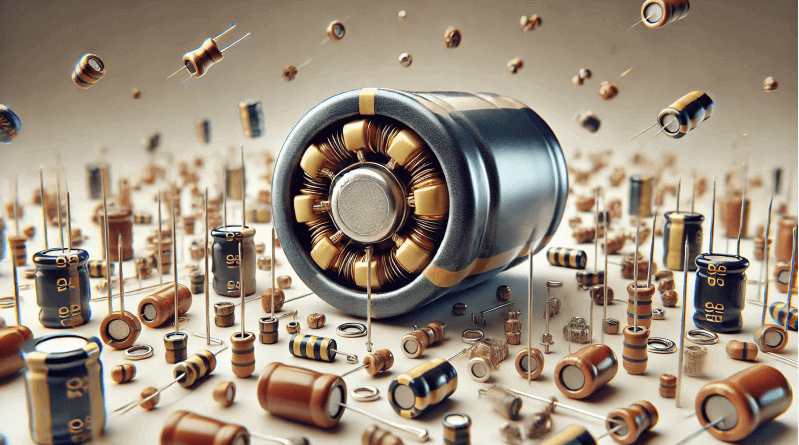
Figure 1. Capacitor
A capacitor is a passive electronic component that temporarily stores electrical energy in an electric field. It consists of two conductive plates, usually aluminum, separated by a non-conductive material called a dielectric. Common dielectric materials include ceramic, plastic, or electrolytic compounds.
When voltage is applied across the plates, an electric field forms as one plate accumulates positive charge and the other negative.
The charge stored in a capacitor depends on both the voltage and the capacitance. This relationship is given by:
Q = C × V
Where:
• Q = charge (in coulombs)
• C = capacitance (in farads)
• V = voltage (in volts)
Capacitance, measured in farads (F), indicates how much charge a capacitor can store per volt. Because one farad is very large for most circuits, values are usually given in microfarads (µF), nanofarads (nF), or picofarads (pF).
Another form, C = dQ/dV, reflects how capacitance responds to changes in voltage and charge.
Capacitors come in various types, each optimized for specific functions based on construction, polarity, and dielectric material.
Electrolytic capacitors offer high capacitance in a compact size and are polarized.
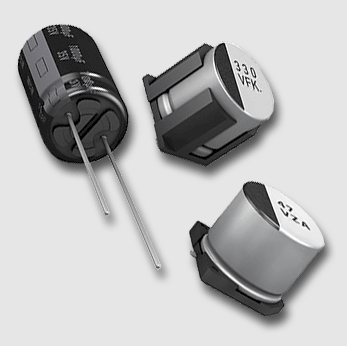
Figure 2. Aluminum Electrolytic
• Aluminum Electrolytic: Common in power supply filters; available in plain or etched foil versions.
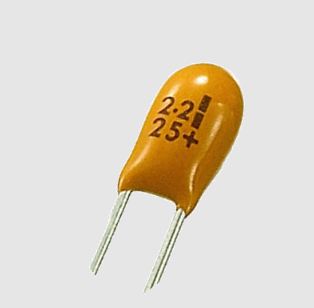
Figure 3. Tantalum Electrolytic
• Tantalum Electrolytic: Known for stability and low leakage current.
They are used for energy storage and filtering, but are unsuitable for AC applications due to polarity requirements.
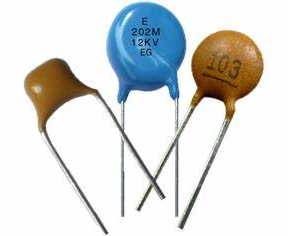
Figure 4. Ceramic Capacitors
Ceramic capacitors are non-polarized, disk-shaped, and ideal for high-frequency applications such as signal bypassing and decoupling. Capacitance ranges from a few pF to 1 μF. Identified by a three-digit code.
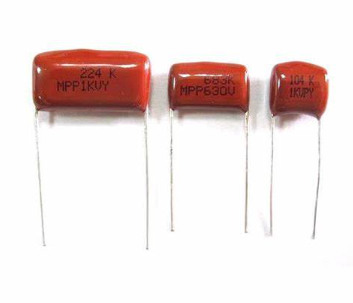
Figure 5. Film Capacitors
Film capacitors use plastic film dielectrics like polyester or polypropylene. Known for low ESR, high stability, and long lifespan. Suitable for both AC and DC use, especially in audio, motor control, and power electronics.
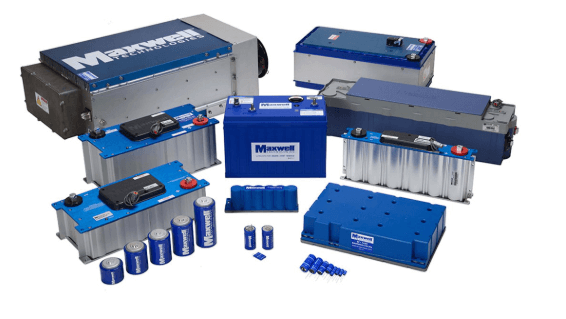
Figure 6. Supercapacitor
Supercapacitors, or ultracapacitors, combine electrostatic and electrochemical energy storage to deliver extremely high capacitance. Capacitance can reach several thousand farads. Ideal for applications requiring rapid charge/discharge, like regenerative braking and backup power.
Capacitors are versatile components used across a wide range of electronic and electrical systems. Their unique ability to store and release energy quickly makes them useful in many functions.
Capacitors can deliver rapid bursts of energy, making them ideal for high-speed energy demands. In camera flashes, they charge quickly and discharge in a single pulse to trigger the flash. In regenerative braking systems of electric vehicles, supercapacitors absorb and release energy efficiently during start-stop cycles. They are also used in pulse power applications such as defibrillators and pulsed lasers, where quick energy discharge is used.
In power supply systems, capacitors stabilize voltage and reduce electrical noise. They smooth out rectified DC output by filtering out voltage ripples, ensuring a consistent supply to sensitive digital components. Additionally, they suppress sudden voltage spikes that could damage ICs and microcontrollers. In uninterruptible power supplies (UPS) and motor drives, capacitors bridge brief power interruptions, improving system reliability.
Capacitors are useful in shaping and conditioning signals. In analog circuits, they pass alternating current (AC) while blocking direct current (DC), allowing signal coupling between stages without DC offset interference. They are needed in audio crossover networks, equalizers, and analog filters. In radio frequency (RF) circuits, capacitors help in tuning and impedance matching for optimal signal transmission and reception.
Capacitors are core components in timing and oscillator circuits. When paired with resistors in RC networks, they control the timing interval by regulating the charge and discharge cycles. This behavior is used in pulse-width modulation (PWM), clock generation, and time delays. Integrated circuits like the 555 timer rely on capacitors to define frequency and timing characteristics in oscillators, blinkers, and pulse generators.
Selecting the appropriate capacitor involves evaluating both electrical specifications and physical constraints to ensure performance, safety, and durability in the intended application.
A capacitor's voltage rating defines the maximum voltage it can handle without risk of dielectric breakdown or failure. Always select a capacitor with a voltage rating at least 20–30% higher than your circuit’s maximum operating voltage. This provides a safety margin to accommodate voltage spikes and transient conditions, especially in power supply and motor control applications.
Temperature affects capacitance stability. Understanding the class of dielectric material helps in selecting a suitable component:
• Class I (e.g., NP0/C0G): Offers excellent thermal stability with minimal capacitance change over temperature. Ideal for precision timing, oscillator circuits, and RF applications.
• Class II (e.g., X7R, X5R): Provides higher capacitance values in a compact size but exhibits greater variation with temperature. Suitable for decoupling and general-purpose filtering where a tight tolerance is less serious.
Different capacitor types behave differently across frequencies:
• Ceramic and Film Capacitors: Have low Equivalent Series Resistance (ESR) and inductance, making them suitable for high-frequency applications such as RF filters, decoupling, and switching power supplies.
• Electrolytic Capacitors: Offer high capacitance values at a lower cost, best suited for low-frequency or bulk energy storage, such as input/output filtering in linear power supplies.
• Surface-Mount Device (SMD): Ideal for compact, automated assembly. Best used in modern consumer electronics and densely packed PCBs.
• Through-Hole: Offers higher mechanical strength and heat dissipation. Preferred in high-power, industrial, or vibration-prone environments.
Always consider available space, power dissipation, and environmental exposure when choosing a package style.
Capacitors can retain a charge long after power is removed, posing potential hazards. Proper safety procedures are required during handling and servicing.
• Discharge Procedures: Before touching or removing a capacitor from a circuit, always discharge it. Use a resistor (typically 1kΩ–10kΩ, rated for adequate wattage) to safely dissipate the stored energy. Avoid using screwdrivers or shorting the terminals directly, as this may cause sparks or damage.
• Safe Disposal: Dispose of old or damaged capacitors according to local e-waste guidelines. Electrolytic capacitors may contain hazardous materials and must not be incinerated or thrown in regular trash. Always check for proper recycling methods.
• Explosion Risks: High-voltage or degraded electrolytic capacitors are prone to rupture or explode, especially if polarity is reversed or voltage ratings are exceeded. Swollen casings, leakage, or hissing sounds indicate danger. Handle such components with caution and replace them promptly.
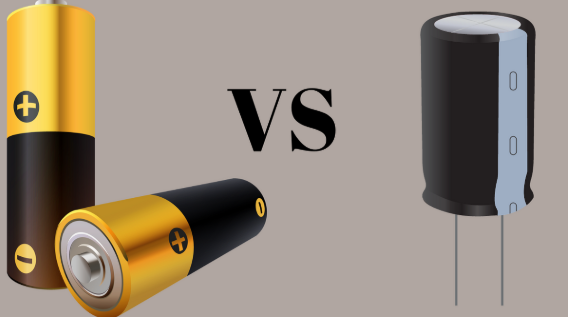
Figure 7. Capacitors vs. Batteries
| Feature | Capacitor | Battery |
| Energy Storage | Stores energy in an electric field between plates | Stores energy through chemical reactions |
| Energy Density | Low – stores less energy per unit volume or weight | High – can store large amounts of energy in compact form |
| Charge/Discharge Speed | Extremely fast – charges/discharges in milliseconds | Slow – takes minutes to hours to charge or discharge |
| Lifespan | Very high – can last millions of cycles without degradation | Limited – loses capacity after hundreds or thousands of charge cycles |
| Maintenance | Virtually maintenance-free | May require monitoring and eventual replacement |
| Polarity Sensitivity | Electrolytic types are polarity-sensitive | Most are not polarity-sensitive |
| Application Focus | Power conditioning, signal filtering, and timing circuits | Long-term energy supply for devices and systems |
| Ideal Use Cases | Smoothing voltage, pulsed power, coupling/decoupling signals | Powering devices like phones, laptops, electric vehicles |
| Environmental Impact | Typically safer and less harmful materials | May contain toxic materials and require recycling |
| Cost | Generally lower cost per component | Higher cost due to complex chemistry and protection circuitry |
Capacitors may be small, but their role in modern electronics is massive. From filtering noise and stabilizing voltage to powering flashes and supporting high-speed circuits, they are needed in countless applications. Understanding the types, how they work, and how to choose the right one helps ensure reliability and safety in your designs. Mastering capacitor basics empowers you to build better, smarter electronic systems. Learning this will help you be well-equipped to handle any capacitor challenge that comes your way.

 Catalogue
 FPGA / CPLD
 Memory
 MOS
MOS  MCU
MCU  DSP
DSP OCEP
OCEP Secondary
  Other
Other 


