
075582814553

Voltage regulators ensure a steady voltage supply, regardless of fluctuations in the input or load conditions. In this article, you’ll learn what voltage regulators do, the different types available, how to choose the right one, and how to troubleshoot common issues, equipping you with the knowledge to design more reliable and efficient electronic systems.
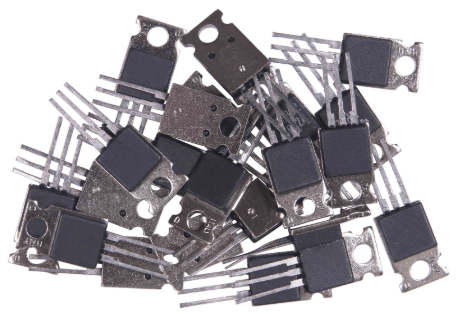
Figure 1. Voltage Regulator
Electronic devices require a stable voltage supply to operate reliably, even when input voltage or load conditions fluctuate. A voltage regulator ensures consistent output by either adjusting internal resistance (linear regulators) or switching energy storage elements (switching regulators).
From computers and smartphones to automotive systems and communication equipment, voltage regulators are needed for protecting circuits from voltage instability, thereby improving performance and extending component lifespan.
Voltage regulators fall into two main categories: linear and switching. Each serves different power, noise, and efficiency requirements.
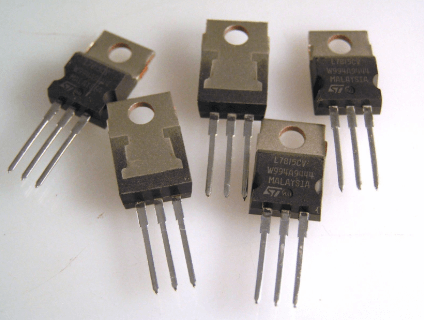
Figure 2. Linear Regulators
Linear regulators offer a clean, low-noise DC output by dissipating excess voltage as heat. They use BJTs or MOSFETs operating in their linear region to keep the output steady. Though simple and affordable, they are inefficient when the input voltage is much higher than the output.
Depending on the voltage control method used, linear regulators are further divided into distinct types suited for specific load conditions.
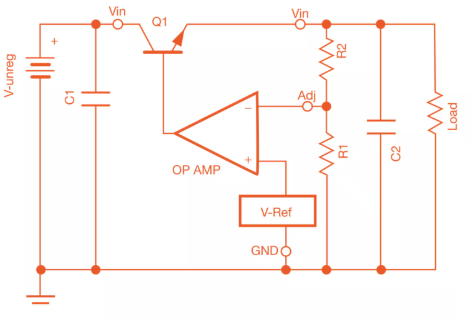
Figure 3. Series Regulator
• Series Regulator: Placed in series with the load, it adjusts voltage across the control element to regulate output. Common in audio and analog systems due to low noise.
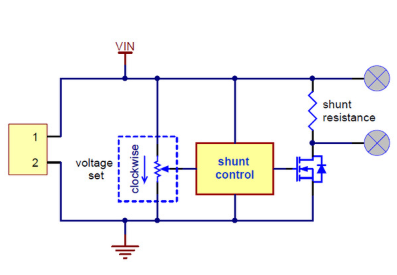
Figure 4. Shunt Regulator
• Shunt Regulator: Connected in parallel with the load, it diverts excess current to ground. Used in low-power circuits like voltage reference systems due to simplicity and cost.
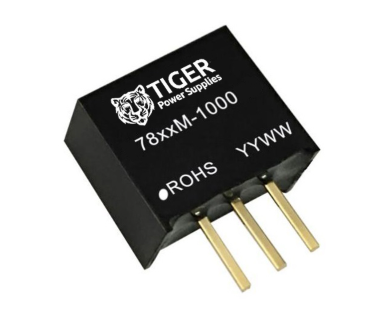
Figure 5. Switching Regulators
Instead of dissipating excess energy as heat, as linear regulators do, switching regulators store and release energy in discrete packets, minimizing power loss.
Switching regulators operate using Pulse Width Modulation (PWM), where the duty cycle determines how much energy is delivered to the output. Due to their fast-switching nature, these regulators generate electrical noise and ripple, which requires additional filtering using inductors and capacitors. Proper layout and shielding are needed to minimize electromagnetic interference (EMI) and maintain stable performance.
Typically, 80–95%, making them ideal for battery-powered or heat-sensitive systems. Due to reduced heat generation, smaller heat sinks or none at all are needed. It can accommodate wide input ranges and provide adjustable or programmable output voltages.
Automotive Systems - Regulators manage battery voltage, power ECUs, and stabilize systems like ADAS and LED lighting. They prevent spikes and ensure consistent performance in varying load conditions.
Industrial Automation - In robotics and control systems, regulators protect motors and sensors from dips and surges, reducing errors and downtime.
Telecommunications - Stable voltage is active in routers, switches, and base stations for uninterrupted data transmission and low signal latency.
Power Distribution - Utility grids and substations use regulators to maintain voltage stability amid changing load demands, improving reliability and power quality.
| Consideration | Description |
| Input & Output Voltage | Ensure the regulator’s voltage range suits your circuit requirements. |
| Output Current Capacity | Choose a regulator that meets or exceeds your load’s current needs. |
| Efficiency | Opt for switching types in energy-critical or battery-powered designs. |
| Noise Performance | Use linear types for low-noise environments like audio or RF systems. |
| Thermal Management | Plan for heat sinks or airflow if using high-power or linear regulators. |
If your circuit shows signs of instability or incorrect output, follow this checklist to diagnose common regulator problems:
• Check Input and Output Voltage: Use a multimeter to confirm the input voltage is within the recommended range. Measure the output to ensure it matches the specified value.
• Inspect for Overheating: Feel for excessive heat or look for discoloration. If overheating is evident, improve thermal management or reduce the load.
• Examine the Load: Remove the load and measure no-load voltage. If the output returns to normal, the load may exceed the regulator’s capacity.
• Verify Capacitor Condition: Aging or incorrect capacitors can cause instability. Compare values and placement to the datasheet recommendations. Replace damaged capacitors as needed.
• Look for Shorts or Open Connections: Check for shorts between the output and ground. Also, inspect PCB traces and solder joints for damage or poor connectivity.
• Review Protection Features: Some regulators include thermal shutdown and current limiting. If the regulator cycles on and off, it may be activating its built-in protection.
• Use an Oscilloscope: For switching regulators, noise and ripple may not be obvious on a multimeter. Use an oscilloscope to assess waveform integrity, ripple voltage, and EMI behavior.
• Stable Output Voltage: Voltage regulators maintain a consistent output voltage regardless of changes in input voltage or variations in load current. This ensures proper operation of electronic circuits and prevents performance issues caused by power fluctuations.
• Protect Sensitive Devices: They protect components from voltage spikes, surges, or dips that could otherwise damage integrated circuits, microcontrollers, or other delicate parts. This is especially important in devices that rely on precise voltage levels.
• Different Types for Different Needs: Linear regulators are simple and ideal for low-noise environments, while switching regulators are more efficient and better for high-power or battery-operated applications. This flexibility allows engineers to choose the best type for their specific needs.
• Low Noise Output (Linear Regulators): Linear regulators produce a smooth and ripple-free DC output, making them ideal for audio, sensor, and analog applications where electrical noise must be minimized.
• High Efficiency (Switching Regulators): Switching regulators convert power more efficiently by rapidly turning on and off, using energy-storing components like inductors and capacitors. This reduces power loss and heat generation, which is ideal for compact or energy-sensitive designs.
• Heat Generation (Linear Type): Linear regulators work by dissipating excess voltage as heat. When the input voltage is significantly higher than the output, the energy loss increases, requiring heat sinks or cooling mechanisms to prevent overheating.
• Low Efficiency (Linear): They are inefficient in scenarios with large voltage differences because the unused energy is wasted as heat, making them unsuitable for high-power applications or battery-operated systems where energy conservation is serious.
• Electromagnetic Interference (Switching Type): Switching regulators generate high-frequency signals that can introduce noise and electromagnetic interference (EMI), potentially affecting nearby sensitive circuits. Additional filtering and shielding are often required.
• More Complex Design (Switching Type): Designing with switching regulators involves careful layout, component selection, and EMI control. This adds complexity to the PCB design and may increase development time and cost.
Voltage regulators are the backbone of stable and efficient electronic performance. Whether you’re working with simple analog circuits or complex digital systems, selecting the right regulator —whether linear or switching —can make a significant difference in power efficiency, thermal management, and noise performance. From automotive electronics to industrial control systems, their role in protecting components and ensuring consistent output is requisite. By understanding how they work, where to apply them, and how to troubleshoot problems, you can build circuits that are not only functional but also resilient and long-lasting.

 Catalogue
 FPGA / CPLD
 Memory
 MOS
MOS  MCU
MCU  DSP
DSP OCEP
OCEP Secondary
  Other
Other 


