
075582814553

Many electronic projects combine devices that use different signal voltages, such as 5V Arduino boards and 3.3V sensors, ESP32 modules, or Raspberry Pi GPIO pins. A logic level converter works as a safe bridge between these voltage systems, helping signals pass correctly without damaging sensitive components. This article explains what logic level converters are, how they work, the common types and ICs available, which options are suitable for I2C, SPI, UART, PWM, and GPIO, and how they compare with other voltage translation methods.
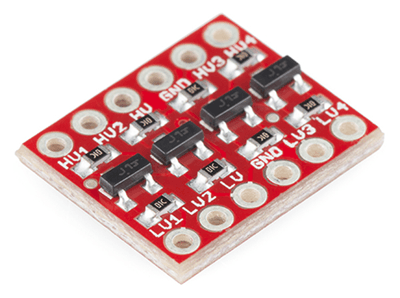
A logic level converter or logic level shifter is a small circuit or module that lets electronic devices with different signal voltages communicate correctly. It is commonly used when a 5V board, such as an Arduino Uno, needs to connect with a 3.3V device like an ESP32, sensor, or display.
Digital devices read signals as HIGH or LOW based on voltage. Common logic levels include 1.8V, 3.3V, and 5V. If one device sends a voltage that is too high, it may damage the receiving chip. If the voltage is too low, the signal may not be detected properly. In some cases, a 3.3V signal can still be read by a 5V input, but this depends on the chip’s input threshold, so the datasheet should always be checked.
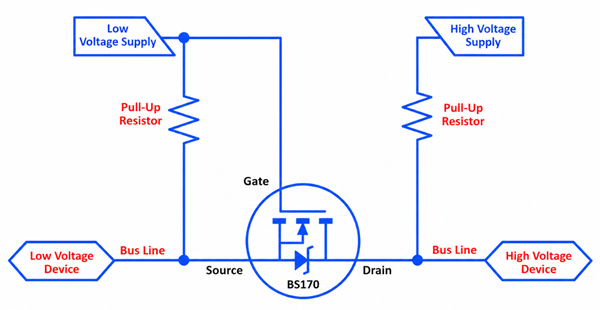
A MOSFET-based logic level converter uses pull-up resistors and a MOSFET to shift signals between low-voltage and high-voltage sides. Each side is pulled up to its own supply voltage, such as 3.3V on the low side and 5V on the high side.
When neither device pulls the line LOW, both sides stay HIGH at their own voltage levels. When either side pulls the signal LOW, the MOSFET conducts and pulls the other side LOW too. This allows bidirectional communication while keeping each device within its safe voltage range.
Logic level converters are commonly divided into bidirectional and unidirectional types. Bidirectional converters allow signals to travel in both directions automatically, making them ideal for open-drain communication protocols such as I2C. Unidirectional converters only transfer signals in one direction, such as converting a 5V output signal to a 3.3V input signal. These are commonly used for fixed-direction communication lines like UART transmit signals, GPIO outputs, and simple digital control interfaces.
MOSFET-based level shifters use transistors and pull-up resistors to translate signals between different voltage levels. They are popular because they are inexpensive, simple, and support automatic bidirectional operation for open-drain buses like I2C. This design is widely used in Arduino projects, ESP32 systems, Raspberry Pi boards, and sensor interfaces. However, MOSFET-based converters may not work reliably for very high-speed communication or push-pull interfaces such as high-speed SPI.
IC-based logic level translators use dedicated integrated circuits designed specifically for voltage translation. These devices usually provide faster switching speed, better signal integrity, and improved reliability for high-speed interfaces such as SPI, SD cards, and parallel communication buses. Common examples include TXS0108E, TXB0108, and 74LVC series chips. Different translator ICs are optimized for different signal types, so selecting the correct device depends on the communication protocol and signal behavior.
Passive resistor divider level shifting uses two resistors to reduce a higher voltage signal to a lower voltage level. This method is simple and low-cost, making it useful for basic one-way signals such as converting a 5V output to a 3.3V input. However, resistor dividers only work in one direction and are not suitable for bidirectional communication. They may also reduce signal quality at higher speeds because resistance and capacitance can slow signal transitions.
Auto-direction translators automatically detect the direction of data flow and adjust signal translation without additional control signals. They simplify wiring and are convenient for many applications. Direction-controlled translators require a dedicated control pin to manually set the signal direction. Although they need more configuration, they often provide better stability and more reliable performance for high-speed communication systems where automatic direction sensing may become unstable.
I2C works well with MOSFET-based bidirectional level converters because I2C uses open-drain lines with pull-up resistors. This is useful when connecting a 5V Arduino to 3.3V sensors, OLED displays, RTC modules, or ESP32 devices. However, pull-up resistor value, cable length, and bus speed can affect reliability.
SPI is faster than I2C and uses push-pull signals, so simple MOSFET level shifters may not work well at high speed. For SPI devices such as SD cards, TFT displays, and flash memory, a faster IC-based translator or buffer is usually better. Poor level shifting can cause data errors, unstable display output, or failed SD card communication.
UART is usually easier to level shift because TX and RX lines have fixed directions. A resistor divider may work for reducing 5V TX to 3.3V RX, while a proper logic translator is safer for reliable long-term use. This is common when connecting USB-to-serial adapters, ESP32 boards, Raspberry Pi UART pins, and GPS modules.
PWM signals need clean voltage transitions, especially in motor drivers, LED dimmers, and MOSFET gate drivers. Low-frequency PWM may work with simple circuits, but high-frequency PWM needs faster translators or buffers. A weak or slow level shifter can cause poor switching, heat, or unstable control.
One-Wire and GPIO signals can also need level shifting when devices use different voltages. Slow GPIO signals can often use simple resistor dividers or transistor circuits, but timing-sensitive signals need better translators. The right choice depends on voltage level, signal speed, direction, and noise sensitivity.
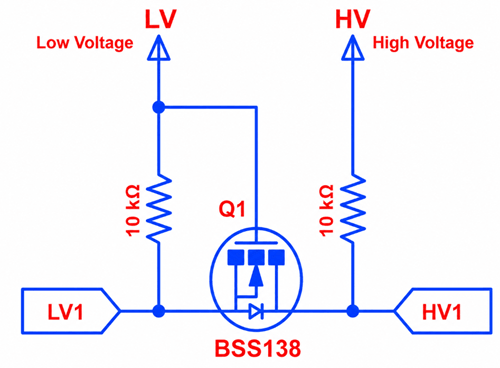
In the circuit, the LV side connects to the low-voltage device, while the HV side connects to the high-voltage device. The pull-up resistors keep both signal lines HIGH, and the BSS138 MOSFET automatically shifts the signal between both sides. When either side pulls the signal LOW, the MOSFET lets the other side follow LOW safely. This allows bidirectional communication while protecting the low-voltage device from higher voltage.
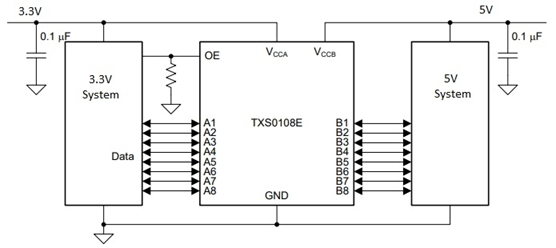
The TXS0108E is an 8-bit bidirectional logic level converter IC used to connect devices operating at different voltages, such as 3.3V and 5V systems. It automatically translates signals between both voltage levels without requiring a direction control pin. In the diagram, the left side operates at 3.3V, while the right side operates at 5V. The TXS0108E safely transfers data between both systems through channels A1–A8 and B1–B8. It is commonly used for GPIO, UART, I2C, and some SPI applications in Arduino, ESP32, and Raspberry Pi projects.The TXS0108E is easy to use and supports automatic bidirectional communication, but it may become unstable with strong pull-up resistors or heavy capacitive loads.
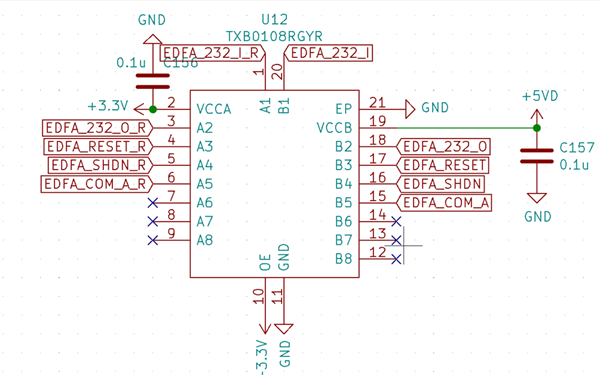
Designed for high-speed digital signal translation between different voltage systems, such as 3.3V and 5V devices. It automatically detects signal direction, so no manual direction control pin is needed. In the diagram above, the TXB0108 connects a 3.3V system on the left side to a 5V system on the right side through channels A1–A8 and B1–B8. It is commonly used for GPIO, UART, and some SPI applications where fast switching and good signal integrity are important. The TXB0108 works well with push-pull digital signals, but it is generally not recommended for I2C communication, strong pull-up resistors, or heavily loaded signal lines.
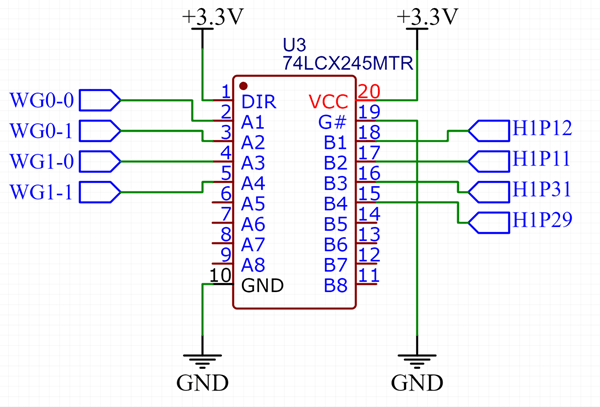
Commonly used for high-speed logic level translation and digital buffering. It uses a DIR (Direction) control pin to manually set the signal direction between the A-side and B-side pins.In the diagram, the IC transfers digital signals between multiple channels while providing stable and fast communication. It is commonly used for SPI interfaces, SD cards, displays, GPIO expansion, and parallel buses where strong signal driving capability is important.
Unlike auto-direction translators, the 74LCX245 provides more reliable performance for high-speed push-pull signals, but it requires manual direction control.
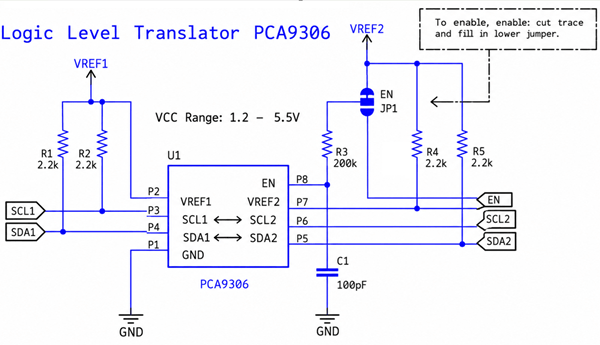
It is optimized specifically for I2C and SMBus communication. In the diagram, the PCA9306 safely translates the SCL and SDA lines between two voltage domains using pull-up resistors and reference voltages (VREF1 and VREF2). It supports automatic bidirectional communication without requiring a direction control pin. The PCA9306 is commonly used in ESP32, Raspberry Pi, sensors, EEPROMs, RTC modules, and other I2C devices because it provides stable and reliable voltage translation for open-drain communication buses.
A logic level converter supports safe communication between devices operating at different voltages, while a voltage divider only reduces voltage using resistors. Logic level converters can support bidirectional communication and better signal integrity, especially for protocols like I2C. Voltage dividers are simpler and cheaper but usually work only for one-way low-speed signals such as basic UART RX lines.
Logic level converters are designed specifically for voltage translation between different logic levels, while buffer ICs mainly strengthen or isolate digital signals. Buffer ICs are often faster and better for high-speed SPI or parallel communication, but many require manual direction control. Logic level converters are generally easier to use for mixed-voltage systems and bidirectional communication.
Logic level converters directly translate signal voltages between circuits that share the same ground, while optocouplers provide electrical isolation between two systems using light-based signal transfer. Optocouplers are commonly used for industrial control and noise isolation, but they are slower and more complex. Logic level converters are faster and better suited for standard embedded communication interfaces.
A direct connection links two devices without voltage translation, which may work only if both devices use compatible logic levels. Logic level converters safely protect low-voltage devices from higher-voltage signals and improve communication reliability. Direct connections between mismatched voltage systems can cause unstable operation or permanent damage to sensitive components.
• Arduino and ESP32 Communication
• Raspberry Pi Sensor Interfaces
• I2C Bus Voltage Translation
• SPI Device Communication
• UART Serial Communication
• OLED and LCD Display Modules
• SD Card Modules
• EEPROM and RTC Modules
• GPIO Signal Translation
• Motor Driver Interfaces
• IoT and Embedded Systems
• FPGA and Microcontroller Interfaces, etc.
Choosing a logic level converter is not only about matching 5V and 3.3V devices. The signal direction, communication speed, and protocol type also matter. For example, MOSFET-based level shifters are usually suitable for I2C and low-speed bidirectional lines, while IC-based translators such as TXS0108E, TXB0108, 74LCX245, and PCA9306 are better for specific uses like GPIO, SPI, or dedicated I2C translation. Before adding one to a circuit, check the voltage levels, input thresholds, bus type, and datasheet limits to make sure the connection is safe and reliable.

 Catalogue
 FPGA / CPLD
 Memory
 MOS
MOS  MCU
MCU  DSP
DSP OCEP
OCEP Secondary
  Other
Other 


