
075582814553

Inside a smartwatch is a compact system of electronic components working together. Understanding these parts helps you know why some smartwatches are faster, more accurate, longer-lasting, or more reliable than others.

A smartwatch is built from many small electronic parts that allow it to work as a wearable device, not just a timekeeping tool. These components are arranged inside a very limited space, so the design must focus on compact size, low power use, stable performance, and user comfort.
The main role of smartwatch electronics is to support daily functions such as time display, notifications, activity tracking, health monitoring, wireless connection, and user control. Each part has a specific task, but the overall design must make them work smoothly without draining the battery too quickly or making the watch too bulky.
Unlike larger devices such as smartphones or tablets, smartwatches have stricter limits in battery capacity, heat control, and internal layout. This is why manufacturers use highly integrated chips, miniature sensors, efficient displays, and optimized power circuits. These choices help the smartwatch stay lightweight while still offering useful features for fitness, communication, and everyday convenience.
Understanding the basic electronic structure of a smartwatch makes it easier to see why performance, battery life, sensor accuracy, and connectivity can vary between models. The next sections will explain the key components in more detail, including the processor, sensors, display, battery system, wireless modules, and how they work together.

The processor and chipset act as the main control center of a smartwatch. They manage app performance, sensor data, notifications, wireless connections, and battery efficiency. In daily use, a better chipset usually means smoother scrolling, faster app loading, more stable tracking, and fewer delays.
Most smartwatches use a System-on-Chip (SoC), which combines several functions into one small chip. This saves space and reduces power use, which is important because smartwatches have small batteries.
High-end chipsets, such as Apple S-series, Samsung Exynos W, and Qualcomm Snapdragon Wear platforms, are designed for better speed, health-data processing, GPS support, and longer software support. Basic chipsets are enough for simple step tracking and notifications, but they may feel slower when using apps, voice assistants, LTE calls, or advanced fitness features.
For users, the processor matters most if they want smooth performance, accurate real-time tracking, reliable connectivity, and longer battery life
Sensors are one of the most important electronic components in a smartwatch because they allow the device to monitor health, movement, fitness activity, and environmental conditions in real time. The quality and accuracy of these sensors greatly affect how useful the smartwatch is in daily use.

Most modern smartwatches include multiple built-in sensors, each designed for a specific function:
• PPG optical heart rate sensor - measures heart rate using LED light
• Accelerometer - detects movement, steps, and wrist motion
• Gyroscope - improves motion tracking and workout detection
• SpO2 sensor - monitors blood oxygen levels
• GPS sensor - tracks running, cycling, and navigation routes
• ECG sensor - detects irregular heart rhythm patterns
• Temperature sensor - monitors skin or body temperature trends
• Ambient light sensor - automatically adjusts screen brightness
In actual use, premium smartwatches usually provide more accurate heart rate tracking during workouts, faster GPS positioning, and more reliable sleep monitoring. Lower-cost smartwatches may support similar features, but tracking accuracy can decrease during intense movement or outdoor activity.
These sensors help solve practical daily problems. For example, GPS sensors help runners track distance accurately without carrying a phone, while heart rate and SpO2 sensors help users monitor fitness recovery and general wellness. Accelerometers and gyroscopes also improve features such as fall detection, gesture control, and automatic workout recognition.

The display is one of the most noticeable components of a smartwatch because it directly affects visibility, battery life, touch responsiveness, and overall user experience. A high-quality display makes notifications easier to read, improves outdoor visibility, and creates smoother interaction during fitness tracking, messaging, and app usage.

Most smartwatches use OLED, AMOLED, or LCD display technologies. AMOLED displays are the most common in premium smartwatches because they provide deeper blacks, higher contrast, better color quality, and lower power consumption during dark-mode operation. OLED and AMOLED displays also support always-on display features more efficiently than traditional LCD panels.
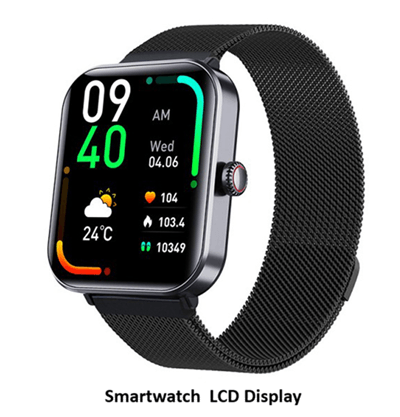
LCD displays are usually found in lower-cost smartwatches. They can still provide good brightness and color accuracy, but they generally consume more power and offer lower contrast compared to AMOLED screens. In direct sunlight, however, some LCD panels may remain easier to read depending on brightness levels and screen coating quality.
Display quality also affects real-world usability:
• Higher brightness improves outdoor visibility
• Higher refresh rates create smoother animations
• Better touch response improves navigation
• Higher resolution makes text and health data easier to read
Premium smartwatches often use AMOLED displays with brightness levels above 1000 nits for better daylight visibility. Lower-end smartwatches may use simpler LCD panels to reduce cost and improve manufacturing efficiency.

Most modern smartwatches use compact lithium-ion or lithium-polymer batteries because they provide high energy storage in a very small size. These batteries power the display, sensors, wireless communication modules, and processors throughout the day. Battery capacity directly affects smartwatch runtime, especially when using GPS, health tracking, or always-on display features.
The Power Management IC (PMIC) controls how power is distributed inside the smartwatch. It regulates battery charging, manages voltage levels for different components, and helps reduce unnecessary power consumption. Efficient PMIC design is one major reason why some smartwatches achieve longer battery life even with smaller batteries.
Smartwatches use compact charging circuits to safely recharge the internal battery. Most devices rely on magnetic charging connectors or wireless charging coils because they save space and improve water resistance. The charging circuit also protects the battery from overcharging, overheating, and excessive current flow.

Many premium smartwatches support wireless charging using inductive charging technology. A charging coil inside the watch receives energy from the charging dock without direct electrical contacts. This improves convenience and reduces connector wear over time.

Some smartwatches support fast charging to quickly restore battery power within a short time. Fast charging is useful for users who rely heavily on health tracking, GPS, or continuous connectivity. However, higher charging speed may generate more heat, so manufacturers carefully balance charging performance and battery longevity.
Smartwatch wireless connectivity modules allow the device to connect with smartphones, earbuds, satellites, payment terminals, and internet services. These modules usually include Bluetooth, Wi-Fi, GPS, NFC, and sometimes LTE or cellular chips. Because a smartwatch has limited space and battery capacity, manufacturers often use compact, low-power wireless chipsets to support reliable communication without draining the battery too quickly.

Bluetooth is the main connection used for notifications, calls, music control, and health data syncing with a smartphone. Wi-Fi helps with faster updates, app access, and cloud syncing, while LTE allows some smartwatches to make calls and send messages without a phone nearby. GPS supports accurate route tracking for running, cycling, and outdoor activities, but it can reduce battery life when used continuously. NFC is mainly used for contactless payments and secure short-range communication.
In real use, the quality of these wireless modules affects how stable the smartwatch feels every day. A well-designed smartwatch should maintain strong Bluetooth pairing, accurate GPS tracking, fast syncing, and safe NFC payment support while still protecting battery life. This is why wireless connectivity is not just an extra feature; it directly affects convenience, fitness accuracy, power efficiency, and overall smartwatch reliability.
The processor of smartwatch controls the system, the sensors collect health and movement data, the display shows useful information, and the wireless modules connect the watch to phones, satellites, and online services. At the same time, the battery, PMIC, and charging circuits supply and manage power so the device can run safely and efficiently. When these components are well-designed and properly balanced, the smartwatch can deliver smoother performance, better tracking accuracy, stronger connectivity, and longer battery life. This is why the quality of each internal component directly affects the real-world experience of using a smartwatch every day.

 Catalogue
 FPGA / CPLD
 Memory
 MOS
MOS  MCU
MCU  DSP
DSP OCEP
OCEP Secondary
  Other
Other 


