
075582814553

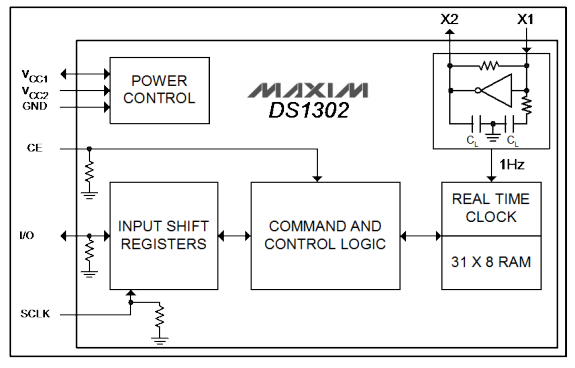
Many electronic projects need to remember the correct time, even when the power is turned off. This is where the DS1302 RTC chip becomes useful. It is a low-cost real-time clock IC that can track seconds, minutes, hours, date, month, year, and leap-year correction up to 2100. It also supports battery backup, a simple 3-wire interface, and small data storage through its 31 × 8 battery-backed RAM. This article will discuss the DS1302’s features, working principle, operating circuit, and more.
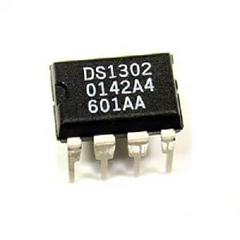
• Real-Time Clock and Calendar - Tracks seconds, minutes, hours, date, day, month, year, and leap-year correction up to 2100.
• 31 × 8 Battery-Backed RAM - Includes internal SRAM for storing small amounts of data during power loss.
• 3-Wire Serial Interface - Uses a simple communication interface with CE, I/O, and SCLK pins.
• Burst Mode Data Transfer - Supports fast multiple-byte read and write operations for clock and RAM data.
• Low Power Consumption - Designed for battery-backed applications with very low standby current.
• Battery Backup Support - Continues timekeeping even when the main power supply is disconnected.
• TTL-Compatible Logic - Compatible with standard TTL and most microcontroller logic levels.
• Wide Operating Voltage Range - Operates from 2.0V to 5.5V for flexible system integration.
• Compact 8-Pin Package - Available in 8-pin DIP and 8-pin SO packages for compact PCB designs.
• Commercial and Industrial Temperature Support - Supports operation from 0°C to +70°C (commercial) and up to -40°C to +85°C (industrial).
• Wide Storage Temperature Range - Can withstand storage temperatures from -55°C to +125°C.
• 260°C Soldering Capability - Supports standard soldering processes during PCB assembly.
The DS1302+
| 0°C to +70°C | 8-PDIP (300 mils) | |
| DS1302S+ | 0°C to +70°C | 8-SO (208 mils) |
| DS1302Z+ | 0°C to +70°C | 8-SO (150 mils) |
| <a href="https://www.y-ic.com/pdf/Analog-Devices-Maxim-Integrated/DS1302ZN(2).html" target="_blank" "="" style="cursor: pointer; color: rgb(0, 0, 238);">DS1302ZN+ | -40°C to +85°C | 8-SO (150 mils) |
• Check accuracy needs - Use DS1302 for basic timing; choose DS3231 for higher precision.
• Match the interface - DS1302 uses 3-wire serial, while DS1307, DS3231, and PCF8563 usually use I2C.
• Consider power use - Choose low-power RTCs for battery-powered or portable devices.
• Check backup support - Make sure the RTC can keep time when main power is off.
• Review external parts - DS1302 needs an external crystal, while DS3231 has a built-in compensated oscillator.
• Match the application - DS1302 fits clocks, timers, and learning projects; DS3231 fits IoT and data logging.
• Balance cost and reliability - DS1302 is cheaper, but DS3231 is better when accuracy matters.

 Catalogue
 FPGA / CPLD
 Memory
 MOS
MOS  MCU
MCU  DSP
DSP OCEP
OCEP Secondary
  Other
Other 


