
075582814553

The DS1307 I2C Real Time Clock is a simple and useful RTC chip for projects that need to keep track of time and date. It can count seconds, minutes, hours, days, months, and years, and it can continue running during power loss by using a backup battery. This article will discuss the DS1307 pin configuration, features, internal operation, microcontroller interfacing, comparison with other RTC chips, applications, and basic PCB design tips.
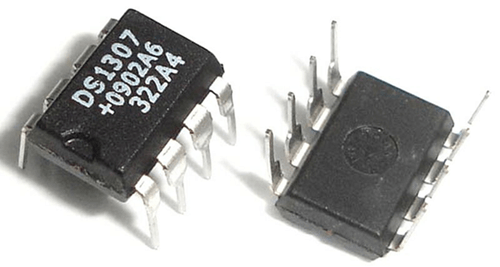
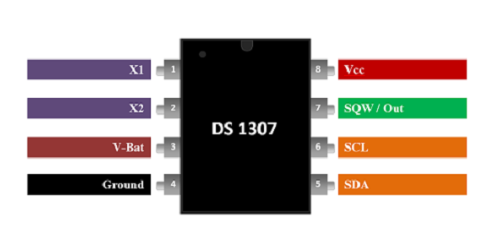
| Pin Number | Pin Name | Description |
| 1 | X1 | Input pin for the 32.768kHz crystal oscillator used for timekeeping. |
| 2 | X2 | Output pin connected to the crystal oscillator circuit. |
| 3 | VBAT | Backup battery input that maintains time and date during main power loss. |
| 4 | GND | Ground connection for the DS1307 RTC IC. |
| 5 | SDA | Serial Data line for I2C communication with the microcontroller. |
| 6 | SCL | Serial Clock line for I2C communication timing. |
| 7 | SQW/OUT | Square-wave or programmable output pin for clock signals. |
| 8 | VCC | Main power supply input for the DS1307 IC. |
| Part Number | Temperature Range | Operating Voltage | Pin Package |
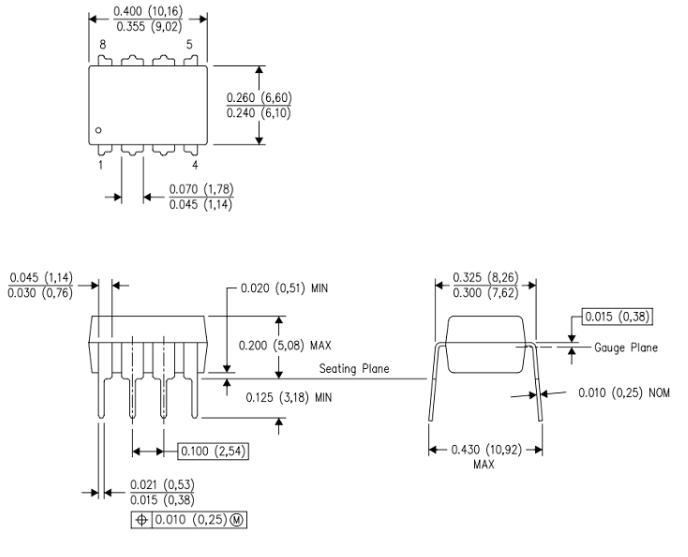
| DS1307N+ | -40°C to +85°C | 5.0V | 8 PDIP (300 mils) |
| DS1307ZN+ | -40°C to +85°C | 5.0V | 8 SO (150 mils) |
| DS1307ZN+TR | -40°C to +85°C | 5.0V | 8 SO (150 mils) Tape and Reel |
• Real-Time Clock and Calendar Function - Tracks seconds, minutes, hours, day, date, month, and year automatically.
• Leap-Year Compensation - Automatically adjusts the calendar for leap years up to the year 2100.
• I2C Serial Communication Interface - Uses a simple 2-wire I2C interface for communication with microcontrollers.
• Battery Backup Support - Maintains accurate timekeeping during main power failure using a backup battery.
• Low Power Consumption - Consumes very low current in battery-backup mode for longer battery life.
• 56-Byte Battery-Backed RAM - Provides non-volatile RAM storage for small data or configuration settings.
• Programmable Square-Wave Output - Generates selectable square-wave signals for timing and clock applications.
• Automatic Power-Fail Detection - Automatically switches between main power and backup battery operation.
• Wide Operating Voltage Range -Supports standard 5V power systems commonly used in embedded electronics.
• Supports 12-Hour and 24-Hour Format - Allows flexible time display configurations.
• Built-In Oscillator Circuit - Works with an external 32.768kHz crystal for accurate timekeeping.
• Compact 8-Pin Package - Available in DIP and SOIC packages for easy PCB integration.
• Industrial Temperature Support - Some versions support operation from -40°C to +85°C.
• Microcontroller Compatible - Easily interfaces with Arduino, ESP32, STM32, Raspberry Pi, and other MCUs.
• Non-Volatile Timekeeping - Retains time and date information even when system power is removed.
• Simple Hardware Requirements - Requires only a crystal, pull-up resistors, and backup battery for operation.
• Reliable Long-Term Time Tracking - Suitable for clocks, data logging, automation, and embedded systems.
• Clock Output Pin (SQW/OUT) - Can output programmable frequencies such as 1Hz, 4kHz, 8kHz, and 32kHz.
• Easy Software Library Support - Widely supported by Arduino and embedded development libraries.
The DS3231 RTC
| PCF8563 RTC | ||||
| Communication Interface | I2C | I2C | 3-Wire Serial | I2C |
| Timekeeping Accuracy | Moderate | Very High | Moderate | Good |
| Internal Crystal | No | Yes | No | No |
| External Crystal Required | Yes | No | Yes | Yes |
| Backup Battery Support | Yes | Yes | Yes | Yes |
| Operating Voltage | 5V | 3.3V–5V | 2V–5.5V | 1V–5.5V |
| Temperature Compensation | No | Yes | No | No |
| Battery-Backed RAM | 56 Bytes | 236 Bytes EEPROM + SRAM | 31 Bytes RAM | No |
| Square-Wave Output | Yes | Yes | Yes | Yes |
| Power Consumption | Low | Very Low | Very Low | Very Low |
| Typical Accuracy Drift | Higher drift over time | Very low drift | Moderate drift | Lower than DS1307 |
| Ease of Arduino Integration | Very Easy | Very Easy | Easy | Easy |
| Cost | Low | Slightly Higher | Low | Low |
| Best Use Case | Basic RTC projects | Precision timing systems | Low-power devices | Compact low-voltage systems |
| Main Advantage | Simple and affordable | Extremely accurate RTC | Low-voltage operation | Efficient low-power design |
| Main Limitation | Lower accuracy | Higher cost than DS1307 | Older communication interface | Limited onboard memory |
The DS1307 is widely used in digital clocks and alarm systems to maintain accurate real-time tracking of hours, minutes, seconds, dates, and calendar information even during power interruptions.
The DS1307 is commonly integrated into Arduino, ESP32, STM32, and Raspberry Pi projects that require real-time scheduling, timing control, or timestamp generation.
In data loggers, the DS1307 provides accurate timestamps for sensor readings, event recording, environmental monitoring, and industrial measurement systems.
IoT systems use the DS1307 to maintain synchronized time for automation, scheduled operations, cloud logging, and network-based monitoring applications.
The RTC can control scheduled lighting, security systems, appliance timers, and automated switching operations in smart home applications.
Industrial control systems use the DS1307 for event timing, maintenance logging, machine operation tracking, and production monitoring.
The DS1307 is useful in embedded devices that must continue tracking time during power failures using backup battery operation.
Many attendance machines and RFID access systems use the DS1307 to record accurate entry and exit timestamps.
The DS1307 can provide backup timekeeping support in navigation and positioning systems when the primary timing source is unavailable.
Medical devices may use the DS1307 for maintaining event logs, patient monitoring timestamps, and scheduled operational timing.
The RTC can be used in dashboard clocks, vehicle monitoring systems, and automotive event-recording applications.
CCTV recorders and surveillance equipment use RTC modules like the DS1307 to maintain accurate timestamps for video and security logs.
When designing a PCB for the DS1307 RTC, proper crystal placement is very important for stable and accurate timekeeping. The 32.768kHz crystal should be placed as close as possible to the X1 and X2 pins to reduce noise and signal interference. Long PCB traces around the crystal can introduce timing instability and increase clock drift over time.
Good power supply filtering also improves RTC reliability. A small decoupling capacitor should be placed near the VCC pin to reduce electrical noise and stabilize the power input. The backup battery circuit should use clean routing to ensure smooth automatic switching between the main supply and battery backup mode during power failure.
The SDA and SCL I2C communication lines should use proper pull-up resistors and avoid running near high-noise switching circuits or motor drivers. Clean PCB grounding and short communication traces help maintain stable I2C communication and reduce data errors.
For long-term reliability, designers should also use a high-quality crystal and stable backup battery because low-quality components can significantly affect time accuracy and battery life in real-world applications.
The DS1307 is a practical RTC solution for basic timekeeping applications because it is affordable, easy to use, and widely supported by microcontrollers such as Arduino, ESP32, STM32, and Raspberry Pi. Its I2C interface, battery backup support, square-wave output, and simple hardware requirements make it suitable for many beginner and embedded projects. However, compared with newer RTC chips like the DS3231, the DS1307 has lower accuracy and may drift more over time. For simple clocks, logging systems, and low-cost projects, the DS1307 is still useful, but for high-accuracy timing, the DS3231 is usually the better choice.

 Catalogue
 FPGA / CPLD
 Memory
 MOS
MOS  MCU
MCU  DSP
DSP OCEP
OCEP Secondary
  Other
Other 


