
075582814553

A solar charge controller is an important device used between solar panels and batteries. Its main job is to control how power flows into the battery so the battery charges safely and does not get overcharged, overheated, or damaged. Without a charge controller, a solar panel may send unstable voltage to the battery, which can reduce battery life or cause system problems. When choosing a solar charge controller, two common options are PWM and MPPT. This article explains how PWM and MPPT solar charge controllers work, how they compare in real applications, and which one is better for different solar system sizes and needs.
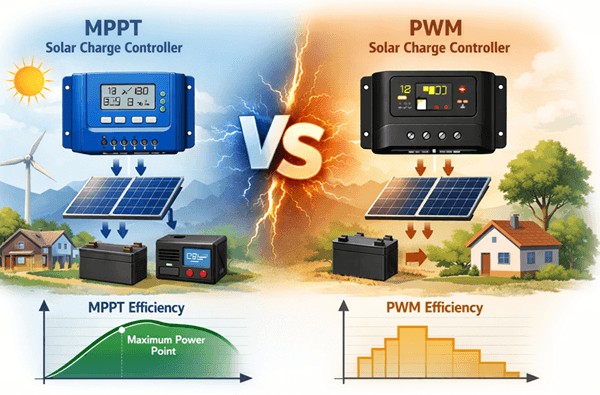
An MPPT (Maximum Power Point Tracking) solar charge controller is an advanced controller that maximizes the power transferred from solar panels to batteries. It uses a DC-DC converter to optimize solar panel output and convert excess voltage into additional charging current, resulting in higher efficiency and faster battery charging.
A PWM (Pulse Width Modulation) solar charge controller is a basic solar charging regulator that controls battery charging by adjusting the connection between the solar panel and battery. It directly matches the solar panel voltage to the battery voltage, making it simpler and more affordable but less efficient than MPPT technology.
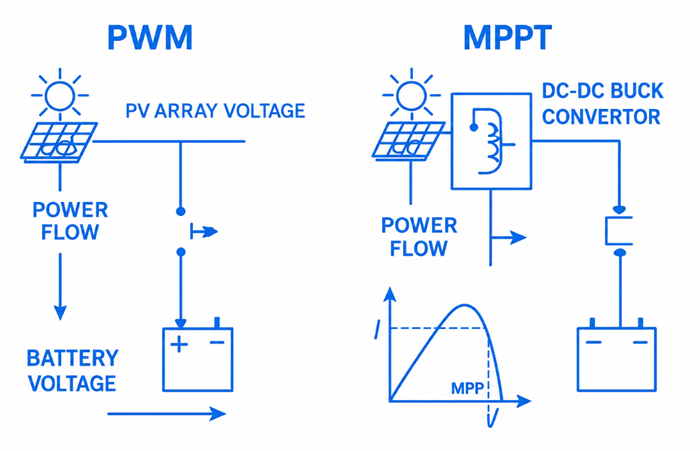
The image shows the main operating difference between PWM and MPPT solar charge controllers. On the MPPT side, the controller includes a DC-DC buck converter and continuously tracks the solar panel’s maximum power point (MPP), which is the point where the panel can generate the highest possible power output.
Unlike PWM controllers, MPPT controllers do not force the solar panel voltage to match the battery voltage directly. Instead, the controller intelligently converts excess solar voltage into additional charging current. This allows the battery to receive more usable power from the same solar panel.
For example, a solar panel may produce 36V while charging a 12V battery system. Rather than wasting the extra voltage, the MPPT controller converts it into higher charging current using its internal DC-DC converter. Because of this voltage conversion process, MPPT systems can charge batteries faster and harvest more solar energy than PWM systems.
As shown in the image, MPPT controllers also track the solar panel power curve to locate the maximum power point. The controller automatically adjusts its operation throughout the day as sunlight intensity, temperature, and weather conditions change. This dynamic tracking helps maintain high charging efficiency even during cloudy weather, morning sunlight, or cold temperatures.
Compared to PWM technology, MPPT controllers are more advanced, more efficient, and better suited for users who want maximum solar energy production and faster battery charging performance.
PWM solar charge controllers operate differently from MPPT systems. In a PWM controller, the solar panel is connected more directly to the battery, causing the panel voltage to operate close to the battery voltage instead of the panel’s true maximum power point.
PWM stands for Pulse Width Modulation, which refers to the controller rapidly switching the charging connection on and off to regulate battery charging safely. During charging, the controller adjusts the pulse width to control the average charging current delivered to the battery while preventing overcharging.
As shown in the diagram, PWM controllers do not contain a DC-DC converter like MPPT systems. Because of this, excess solar panel voltage cannot be converted into additional charging current. For example, if an 18V solar panel charges a 12V battery, some of the available voltage is effectively unused. This is why PWM systems generally produce lower charging efficiency compared to MPPT systems.
PWM controllers work best when the solar panel voltage closely matches the battery voltage. In small solar systems, this simpler charging method can still provide stable and reliable operation. Many portable solar kits, small RV systems, garden lighting systems, and basic off-grid setups use PWM controllers because they are affordable, easy to install, and have a simpler internal design.
Although PWM controllers are less efficient overall, they remain a practical option for users with smaller solar systems and limited budgets. However, compared to the MPPT, PWM systems usually harvest less solar energy, especially during cold weather, low-light conditions, or when using higher-voltage solar panels.
MPPT controllers usually charge batteries faster because they can deliver more usable charging current from the same solar panel setup. This is especially noticeable when sunlight changes during the day or when the solar panel voltage is higher than the battery voltage. PWM controllers can still charge batteries safely, but their charging speed is usually lower because they cannot fully use the extra panel voltage.
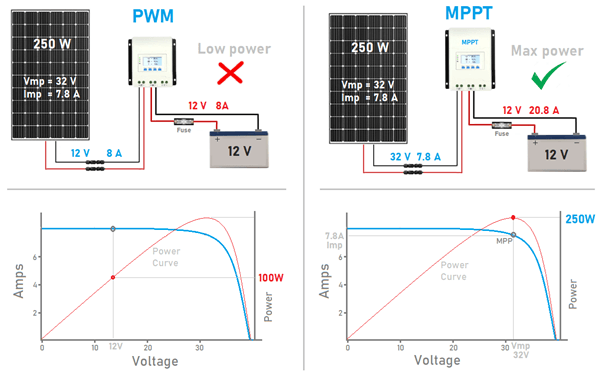
For battery type compatibility, both PWM and MPPT controllers can work with lead-acid, AGM, gel, and lithium batteries as long as the controller supports the correct charging profile. However, MPPT controllers are often a better choice for lithium battery systems because they usually offer more adjustable charging settings, better monitoring, and higher charging efficiency. PWM controllers are more suitable for simple lead-acid or AGM battery setups where the system size is small and charging demand is not high.
In real conditions, MPPT performs better when sunlight is weak, temperatures are low, or the solar array produces more voltage than the battery needs. PWM is acceptable for small systems, but MPPT provides more consistent charging performance for users who want faster recovery, better energy harvest, and improved battery use throughout the day.
PWM controllers need the solar panel voltage to be close to the battery voltage. For example, a typical 12V solar panel works well with a 12V battery system. If the panel voltage is much higher than the battery voltage, a PWM controller cannot properly convert that extra voltage into useful charging current, so part of the available solar power is wasted.
MPPT controllers are more flexible because they can work with higher-voltage solar panels and convert the extra voltage into usable battery charging power. This makes MPPT better for larger solar arrays, series-connected panels, and systems where the panels are installed far from the battery bank.
For long cable distances, MPPT has an advantage because higher-voltage panel wiring can reduce current flow and lower cable power loss. PWM is still a practical choice for small matched-voltage systems with short wiring, such as small RV kits, portable solar chargers, and basic off-grid lighting systems.
| Solar System Size | PWM Solar Charge Controller | MPPT Solar Charge Controller | Recommended Choice |
| Small Systems (50W–200W) | Low cost, simple installation, suitable for basic lighting, small battery charging, and portable solar kits | Higher efficiency but may cost more than the entire small system setup | PWM is usually more practical for budget-friendly small systems |
| Medium Systems (200W–800W) | Works for basic setups but may lose noticeable solar power in changing weather conditions | Better energy harvest, faster charging, and improved efficiency throughout the day | MPPT is generally the better long-term choice |
| Large Systems (800W–2000W) | Lower efficiency becomes more noticeable as system size increases | Significantly better charging performance and solar energy utilization | MPPT is strongly recommended |
| Large Off-Grid Systems (2000W+) | Usually not ideal due to efficiency limitations and voltage restrictions | Supports high-voltage arrays, series wiring, and long cable distances efficiently | MPPT is the preferred solution |
| RV and Camper Solar Systems | Good for small and low-power RV systems | Better for larger RV systems with lithium batteries and multiple appliances | Depends on system size and power demand |
| Home Backup Solar Systems | Suitable only for small emergency backup systems | Better battery charging control and higher energy harvest for daily use | MPPT is recommended |
| High-Voltage Solar Panel Systems | Limited compatibility because panel voltage must closely match battery voltage | Designed for high-voltage solar panels and flexible panel configurations | MPPT is the better option |
| Budget DIY Solar Projects | Very affordable and easy for beginners | Higher upfront cost but better efficiency | PWM for low-cost projects, MPPT for long-term performance |
Case 1: Small RV Solar System
A PWM controller is commonly used in small RV systems with a single 12V solar panel and a lead-acid battery. It provides affordable and reliable charging for lights, phone charging, and small appliances.
Case 2: Solar Garden Lighting
PWM controllers are widely used in solar garden lights and small outdoor lighting systems because they are simple, low cost, and suitable for low-power applications.
Case 3: DIY Off-Grid Cabin Setup
A small off-grid cabin with basic lighting and short cable distances can use a PWM controller effectively when the solar panel voltage matches the battery voltage.
Case 1: Home Solar Backup System
An MPPT controller is ideal for residential battery backup systems because it provides faster charging, better efficiency, and improved energy harvesting throughout the day.
Case 2: Large RV or Camper Solar Setup
Large RV systems with multiple solar panels, lithium batteries, refrigerators, and inverters benefit from MPPT technology because it can handle higher power demand more efficiently.
Case 3: Long-Distance Solar Panel Installation
MPPT controllers are commonly used when solar panels are installed far from the battery bank. Higher panel voltage helps reduce cable power loss and improves overall system efficiency.
Choosing between PWM and MPPT depends on your system size, budget, battery type, panel voltage, and energy demand. PWM is better for small, simple, and low-cost solar systems, while MPPT is better for larger systems that need higher efficiency and stronger charging performance. For small setups like solar lights, small cabins, or basic off-grid systems, PWM can be enough. It is cheaper, easier to use, and reliable when the solar panel voltage closely matches the battery voltage.
For larger systems, MPPT is usually the better choice. It can convert extra panel voltage into useful charging current, which helps produce more usable power. This is useful for homes, larger battery banks, lithium batteries, and areas with changing sunlight. Budget is also important. PWM is a good choice if you want the lowest upfront cost. MPPT costs more, but it can be worth it if your system needs better energy harvest, longer cable runs, or higher-voltage solar panels.
Battery type should also be considered. Lead-acid batteries can work with both PWM and MPPT, but lithium batteries usually benefit more from MPPT because they need more accurate charging control. You should also consider weather and sunlight conditions. If your area has stable sunlight and low power demand, PWM can work well. If sunlight changes often because of clouds, shade, or weather, MPPT can adjust better and collect more energy.
| Common Mistake | Why It Is a Problem | Possible Result |
| Choosing the controller based only on price | Cheap controllers may have poor efficiency, weak protection features, or unreliable performance | Reduced system reliability and shorter component lifespan |
| Using a PWM controller with high-voltage solar panels | PWM controllers cannot efficiently use excess panel voltage | Lower charging efficiency and wasted solar power |
| Buying an undersized controller | The controller may not handle the solar panel current safely | Overheating, shutdown, or controller damage |
| Ignoring battery type compatibility | Different batteries require different charging profiles | Poor charging performance or battery damage |
| Using fake or low-quality MPPT controllers | Some low-cost products are labeled as MPPT but actually use PWM technology | Lower efficiency and poor system performance |
| Incorrect solar panel voltage matching | The controller may not properly regulate charging voltage | Charging instability or reduced energy harvest |
| Ignoring cable distance and voltage drop | Long cable runs can reduce charging efficiency | Power loss and slower battery charging |
| Choosing PWM for large solar systems | PWM efficiency losses become more noticeable in larger systems | Lower total energy production |
| Not checking protection features | Missing protections increase system risk | Possible battery overcharge, overheating, or short-circuit damage |
| Failing to plan for future expansion | The controller may not support additional solar panels later | Extra upgrade cost or full controller replacement |
PWM and MPPT solar charge controllers both help keep solar battery systems safe and reliable, but they are not best for the same situations. In general, choose PWM if your system is small and budget-focused, but choose MPPT if you want better solar energy harvest and stronger overall charging performance.

 Catalogue
 FPGA / CPLD
 Memory
 MOS
MOS  MCU
MCU  DSP
DSP OCEP
OCEP Secondary
  Other
Other 


