
075582814553

This article will discuss the MG90S servo’s pinout, PWM signal control, internal working process, key specifications, real-world performance, Arduino control method, and comparison with the SG90 servo.
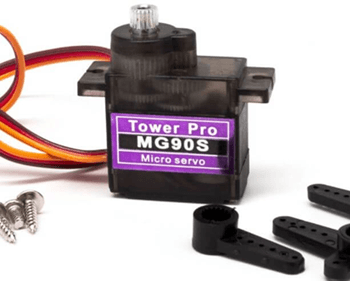
The MG90S Metal Gear Micro Servo Motor is a small rotary actuator designed for accurate angle control. Unlike a regular DC motor that spins continuously, the MG90S moves to a set position using a control signal, usually within a 0° to 180° range.
It has an internal DC motor, metal gear system, feedback sensor, and control circuit inside a compact body. Its metal gears give it better strength and durability than plastic gear micro servos. Because of its small size, stable movement, and easy control, the MG90S is a practical choice for projects that need compact and precise motion.
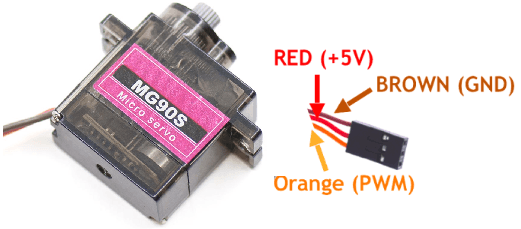
| Pin/Wire Color | Function | Description |
| Red | VCC (+5V) | Supplies power to the MG90S servo motor. It typically operates between 4.8V and 6V. |
| Brown | GND (Ground) | Connects to the system ground to complete the electrical circuit. |
| Orange | PWM Signal | Receives the Pulse Width Modulation (PWM) control signal from a microcontroller or servo controller to set the servo position. |
The MG90S works using a Pulse Width Modulation (PWM) control signal sent through the orange signal wire. The servo receives power through the red wire and ground through the brown wire.
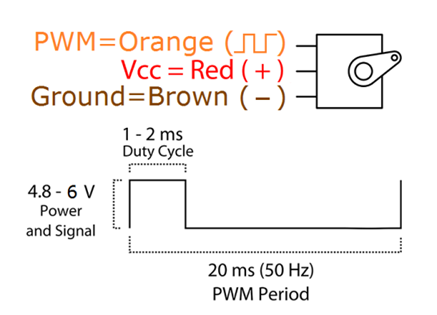
Internally, the MG90S contains a small DC motor, metal gears, a control circuit, and a feedback potentiometer. The control circuit continuously reads the PWM pulse width and compares it with the current shaft position measured by the potentiometer.
The diagram shows a standard 20 ms PWM period operating at 50 Hz. Inside this cycle, the pulse width usually ranges from about 1 ms to 2 ms:
• Around 1 ms moves the servo close to 0°
• Around 1.5 ms centers the servo
• Around 2 ms moves the servo near 180°
When the received signal does not match the current position, the internal motor rotates the gears until the target angle is reached. This closed-loop feedback system allows the MG90S to maintain accurate positioning automatically.
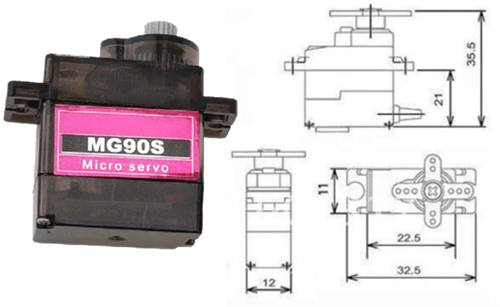
The MG90S has a compact body with dimensions of approximately 22.5 × 12 × 35.5 mm and a weight of only 13.4 g. Its small size allows it to fit into tight mechanical spaces while keeping the overall system lightweight.
The servo uses a metal gear system instead of plastic gears. This improves mechanical strength, wear resistance, and durability during repeated movement and continuous operation.
The MG90S operates between 4.8 V and 6.0 V. Higher supply voltage can improve torque and rotational speed performance.
The servo provides approximately 1.8 kgf·cm torque at 4.8 V and up to 2.2 kgf·cm at 6 V. This allows it to handle moderate mechanical loads for precise motion control.
The MG90S offers a rotation speed of about 0.1 s/60° at 4.8 V and 0.08 s/60° at 6 V, allowing faster response and smoother movement.
With a dead band width of 5 μs, the MG90S can maintain better positioning accuracy and stable angle control during operation.
| Parameter | MG90S | SG90 |
| Gear Material | Metal gears | Plastic gears |
| Weight | About 13.4 g | About 9 g |
| Torque | 1.8–2.2 kg·cm | 1.2–1.8 kg·cm |
| Operating Voltage | 4.8 V – 6 V | 4.8 V – 6 V |
| Rotation Range | Approximately 180° | Approximately 180° |
| Durability | Higher durability | Lower durability |
| Mechanical Strength | Better under load | Better for light loads |
| Operating Speed | Faster response | Slightly slower |
| Noise Level | Slightly noisier | Quieter |
| Power Consumption | Higher | Lower |
| Position Stability | More stable during repeated movement | Less stable under heavier load |
| Cost | Slightly more expensive | More affordable |
| Best Feature | Stronger and more durable | Lightweight and budget-friendly |
| Suitable For | Moderate mechanical movement | Simple lightweight movement |
The MG90S performs well in projects that require compact size, accurate movement, and moderate torque. Its metal gear system provides better durability than plastic gear servos, allowing it to handle repeated movement and light mechanical loads more reliably. The servo also offers stable positioning and relatively fast response, making motion control smoother during operation.
In real use, the MG90S works best when supplied with stable power between 4.8 V and 6 V. Poor power sources may cause jitter, weak holding force, or unstable movement. Although the metal gears improve strength, they can produce slightly more noise compared to plastic gear servos. The MG90S is considered a reliable micro servo for systems that need a balance between size, torque, speed, and durability.
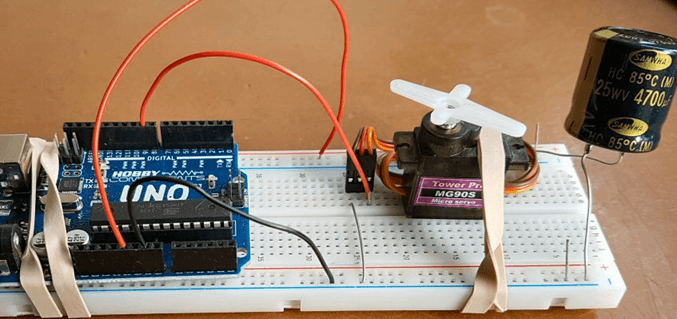
The MG90S can be controlled easily using an Arduino through a PWM signal. The servo has three wires: the red wire connects to the 5V power supply, the brown wire connects to GND, and the orange wire connects to one of the Arduino PWM-capable digital pins.
The Arduino sends PWM pulses to the MG90S to control the shaft angle. A pulse width of about 1 ms usually moves the servo near 0°, 1.5 ms centers it, and 2 ms moves it close to 180°. The servo continuously reads these signals and adjusts its internal motor position automatically.
For stable operation, it is recommended to use a proper external 5V supply when driving the servo under load, since powering it directly from the Arduino board may cause unstable movement or jitter.
• Robotic arm joint control
• Pan-tilt camera systems
• RC airplane control surfaces
• RC car steering mechanisms
• Quadcopter accessory movement systems
• Robot grippers and claws
• Small humanoid robot movement
• Arduino and ESP32 motion projects
• Automated door lock mechanisms
• Sensor scanning platforms
• Lightweight CNC and positioning systems, etc.
Choosing the right servo motor depends on the required torque, size, speed, operating voltage, and durability of the system. Small servos like the MG90S are suitable when compact size, accurate positioning, and moderate mechanical strength are needed. For lighter movement and lower cost, plastic gear servos may be enough, while metal gear servos are better for repeated movement and higher mechanical stress.It is also important to consider the power supply and load conditions. A servo with insufficient torque may struggle to move the mechanism properly, while an oversized servo can increase power consumption and system weight unnecessarily. Selecting the correct servo helps improve movement stability, positioning accuracy, and long-term reliability.

 Catalogue
 FPGA / CPLD
 Memory
 MOS
MOS  MCU
MCU  DSP
DSP OCEP
OCEP Secondary
  Other
Other 


