
075582814553

A crystal oscillator is an electronic circuit that uses a quartz crystal to create a stable and accurate clock signal, which acts like the timing heartbeat of processors, microcontrollers, communication circuits, GPS devices, and industrial equipment. Its history goes back to early radio and frequency control, when engineers needed more stable frequency sources than older oscillator designs. This article will discuss how crystal oscillators work, their types, frequency stability, and more.
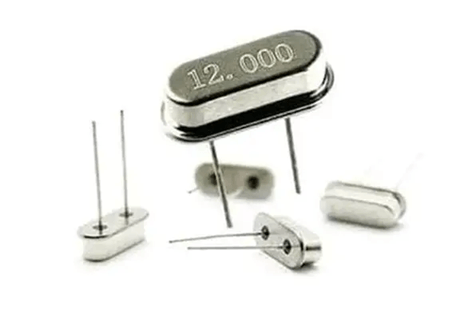
Crystal oscillators generate stable clock signals by using the natural vibration characteristics of a quartz crystal. As shown in Figure 2, electrical current is applied to the quartz crystal, causing the material to vibrate through a phenomenon called the piezoelectric effect. The piezoelectric effect allows quartz to convert electrical energy into mechanical vibration and then convert those vibrations back into electrical signals. Because quartz vibrates at a highly precise and repeatable frequency, it becomes an excellent source for accurate timing and clock generation in electronic systems.
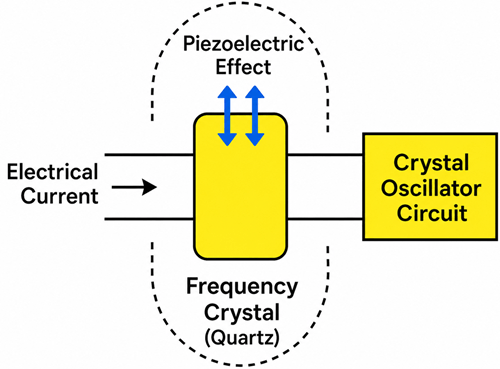
The quartz crystal also acts as a resonator. Similar to how a tuning fork vibrates at one specific tone, the crystal naturally resonates at a particular frequency determined by its physical shape, thickness, and cut. Once energized, the crystal strongly favors this resonant frequency while reducing unwanted frequencies and electrical noise. This resonance is what allows crystal oscillators to produce highly stable clock signals used in microcontrollers, processors, communication equipment, computers, and digital systems.
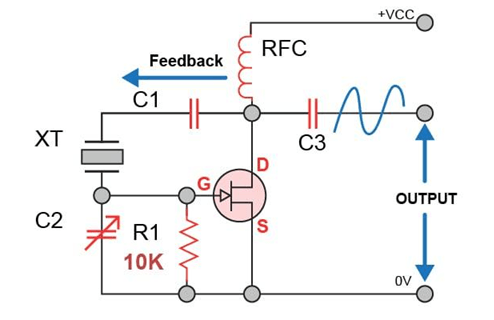
As shown in Figure 3, the oscillator circuit contains an amplifier and a feedback network that continuously sustain the oscillation. The amplifier strengthens the weak signal generated by the vibrating crystal, while the feedback path returns part of the output signal back into the crystal circuit. This continuous loop keeps the crystal vibrating without interruption. Components such as capacitors and the amplifier stage help maintain the correct operating conditions needed for stable oscillation and signal generation.
The oscillation remains stable over time because quartz crystals have very high frequency precision and low energy loss. Their resonant properties help reduce the effects of electrical noise, voltage variation, and small environmental changes. In more advanced crystal oscillator designs, additional temperature compensation or control circuits may also be used to minimize frequency drift caused by temperature changes and crystal aging. This long-term stability is why crystal oscillators are widely used in systems that require accurate timing, synchronization, reliable data transfer, and stable clock generation.
This classification is based on how the quartz crystal operates within the oscillator circuit and how the resonant frequency is used for signal generation.
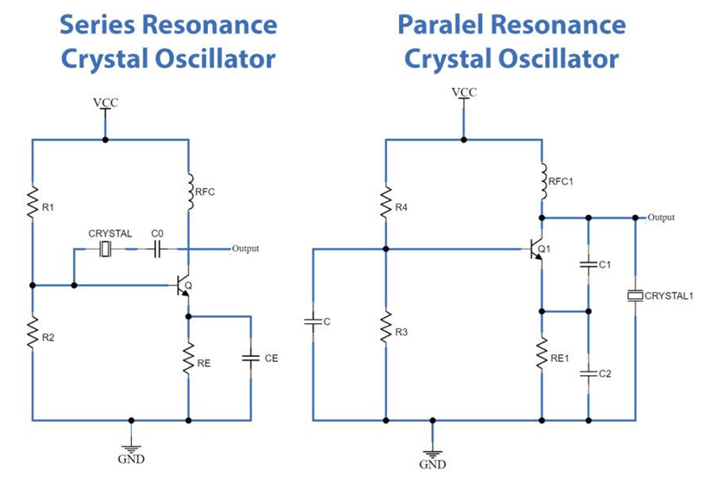
A parallel crystal oscillator operates near the crystal’s parallel resonant frequency. In this configuration, the crystal works together with external load capacitances connected in the oscillator circuit. The capacitors affect the final operating frequency, allowing the circuit to stabilize at a slightly different frequency than the crystal’s natural series resonance. One important characteristic of parallel crystal oscillators is that the operating frequency depends partly on the external capacitor values. Incorrect load capacitance can shift the oscillator frequency or reduce stability.
A series crystal oscillator operates near the crystal’s series resonant frequency, where the crystal impedance becomes very low. In this mode, the crystal behaves almost like a very small resistance in the signal path, allowing the oscillator to operate at a frequency determined mainly by the crystal itself rather than by external capacitors. Compared to parallel oscillators, series crystal oscillators are often used in circuits requiring narrow frequency control or specialized RF behavior. However, the oscillator circuit must be carefully designed to ensure proper startup and stable oscillation.
This classification focuses on the oscillator’s stability, frequency control capability, temperature performance, and precision level.
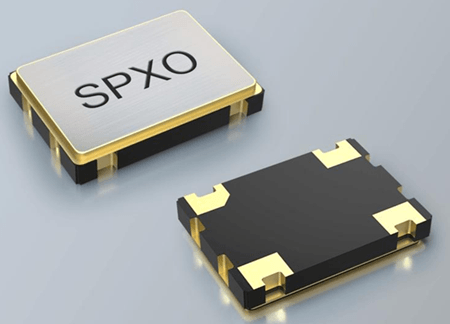
An XO, also called SPXO (Simple Packaged Crystal Oscillator). This combines a quartz crystal with an oscillator circuit inside a compact package to generate a fixed-frequency clock signal. However, standard XOs have limited temperature compensation, so their frequency can drift slightly with temperature changes, aging, and environmental conditions.
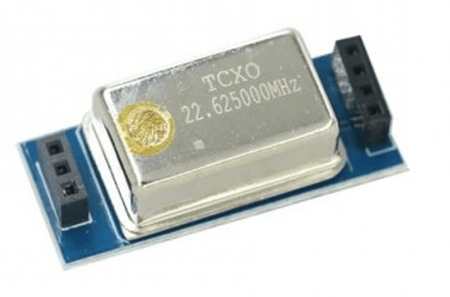
A TCXO improves frequency stability by compensating for temperature-related frequency drift. Since quartz crystals naturally change frequency as temperature changes, a TCXO uses compensation circuitry to automatically correct these variations. Compared to standard XOs, TCXOs provide significantly better frequency stability while still maintaining relatively low power consumption and compact size.
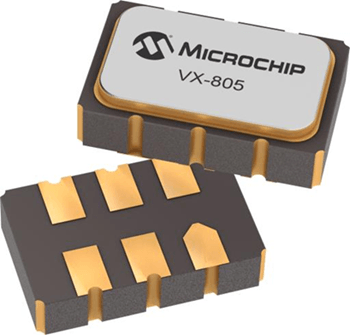
A VCXO allows the oscillator frequency to be adjusted electronically using an external control voltage. Instead of producing only one fixed frequency, the oscillator can slightly shift its output frequency within a controlled range. The tuning range of a VCXO is usually small compared to other tunable oscillators, but it provides very precise frequency control.
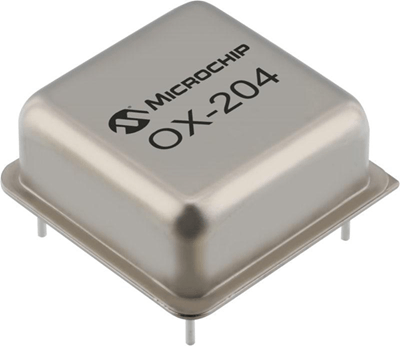
An OCXO provides extremely high frequency stability by placing the crystal inside a temperature-controlled chamber called an oven. The crystal is kept at a constant elevated temperature, minimizing the effects of environmental temperature changes on frequency stability. However, OCXOs are generally larger, more expensive, and consume more power than other crystal oscillator types because of the internal heating system.
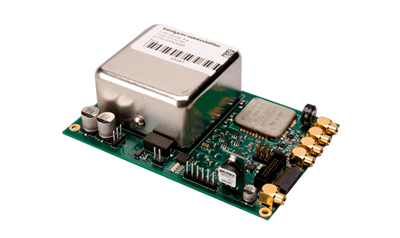
A GPS-disciplined oscillator combines a highly stable crystal oscillator with timing signals received from GPS satellites. The GPS reference continuously corrects the oscillator frequency, allowing the system to maintain extremely accurate long-term timing stability. Because GPS satellites use atomic clock references, GPSDO systems can achieve extremely accurate frequency and timing performance over long periods.
In real electronic systems, the clock signal generated by the oscillator controls timing, synchronization, signal processing, and data transfer accuracy. Even a very small frequency error can affect communication reliability, GPS positioning accuracy, processor timing, RF transmission quality, and overall system stability.
Crystal oscillator accuracy is commonly specified in parts per million (ppm). PPM describes how much the actual output frequency may deviate from its ideal frequency. A lower ppm value means higher accuracy and better stability.
For example, a 10 MHz crystal oscillator rated at ±10 ppm can vary by:
• ±100 Hz from the nominal 10 MHz frequency
• 1 ppm at 10 MHz equals 10 Hz
• 50 ppm at 10 MHz equals 500 Hz
Although these numbers appear small, even slight frequency errors can create major problems in high-speed digital systems, wireless communication, GPS synchronization, and RF transmission.
For comparison:
| Oscillator Type | Typical Stability |
| Standard XO/SPXO | ±20 to ±100 ppm |
| TCXO | ±0.5 to ±5 ppm |
| OCXO | ±0.01 to ±0.1 ppm |
| GPSDO | Extremely low long-term error |
Temperature is one of the biggest causes of frequency drift in quartz crystals. As temperature changes, the physical dimensions and electrical properties of the crystal slightly change, causing the resonant frequency to shift.
In consumer electronics, small frequency drift may not cause noticeable problems. However, in RF systems, wireless communication, industrial automation, and precision timing systems, even small temperature-induced drift can reduce synchronization accuracy and signal reliability.
For example:
• In wireless communication systems, frequency drift can shift carrier frequencies and reduce signal quality.
• In GPS receivers, unstable timing can reduce positioning precision.
• In serial communication systems, excessive clock mismatch can increase data transmission errors.
• In RF transmitters, unstable oscillators may increase interference with nearby channels.
This is why TCXOs and OCXOs are commonly used in systems exposed to changing environmental temperatures. A TCXO electronically compensates for temperature drift, while an OCXO keeps the crystal inside a controlled heated chamber to maintain highly stable operation.
Quartz crystals also experience gradual frequency changes over long periods, commonly called aging drift. Aging occurs because of slow physical and chemical changes inside the crystal structure, contamination, mechanical stress, and long-term material relaxation.
Most crystal oscillators experience larger drift during the first year of operation before stabilizing over time. Typical aging rates may range from:
• ±1 ppm to ±5 ppm per year for standard oscillators
• Much lower aging rates for precision OCXO systems
High-end oscillators are carefully designed to minimize aging effects through crystal processing, temperature control, and precision manufacturing techniques.
Poor clock accuracy can create both visible and hidden problems in electronic systems. In simple consumer electronics, the effects may appear as incorrect timing or unstable operation. In advanced systems, the consequences can become much more serious.
For example, in microcontroller systems, unstable clock signals may cause incorrect instruction timing or communication failures between peripherals. In SDR (software-defined radio) systems, oscillator instability can distort modulation and reduce signal quality. In industrial automation systems, timing drift may affect synchronized motor control and sensor coordination.
Because clock signals control the timing foundation of electronic systems, oscillator stability directly affects overall system reliability, performance, and accuracy. This is why selecting the correct crystal oscillator type is critical in both consumer and high-performance electronic designs.
Phase noise and jitter describe how clean and stable a crystal oscillator’s output signal is. As shown in the image below, the left side represents the time domain, where small shifts in the waveform show timing variation. This timing variation is called jitter. In digital systems, jitter means the clock edge does not arrive at the exact expected time. It may arrive slightly early or slightly late, which can affect data transfer, signal sampling, and synchronization.
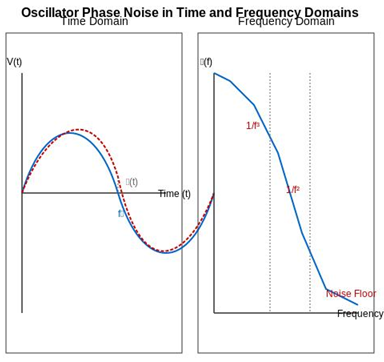
The right side of the image shows the frequency domain, where oscillator noise appears around the intended frequency. This is called phase noise. A perfect oscillator would produce energy only at one exact frequency, but real oscillators always have small noise around the carrier signal. Lower phase noise means the oscillator produces a cleaner and more accurate clock signal.
Low jitter and low phase noise are important in RF, communication, and high-speed systems. In RF circuits, phase noise can spread energy into nearby frequencies and reduce signal clarity. In communication links, clock instability can increase bit errors and weaken synchronization. In ADC systems, jitter can reduce sampling accuracy, especially when measuring fast or high-frequency signals. This is why low-noise crystal oscillators are preferred in telecom, networking, radar, precision measurement, and high-speed digital designs.
Crystal oscillators can fail or become unstable when the circuit, layout, power supply, or environment does not support proper oscillation. These problems can cause startup failure, frequency drift, jitter, or complete clock loss.
Startup failure happens when the oscillator cannot build enough signal to begin oscillation. This may be caused by low amplifier gain, wrong component values, or an unsuitable crystal.
Too much load capacitance can slow startup, shift the frequency, or stop oscillation. The capacitor values should match the crystal’s required load capacitance.
Long traces, noisy routing, and poor grounding can disturb the oscillator signal. The crystal should be placed close to the IC with short, clean traces.
Temperature changes can shift the crystal’s frequency. In harsh environments, TCXO or OCXO types are better for stable timing.
Quartz crystals are mechanical devices, so strong vibration or impact can affect frequency stability or damage the crystal.
Over time, quartz crystals slowly change frequency due to aging. This matters in systems that need long-term timing accuracy.
Noisy power can increase jitter and make the clock unstable. Good filtering and proper decoupling help keep the oscillator signal clean.
| Feature | Crystal Oscillator | Crystal Resonator |
| Main Function | Generates a complete clock signal | Provides basic frequency resonance |
| Accuracy | Very high | Moderate |
| Frequency Stability | Excellent | Lower than crystal oscillators |
| Frequency Drift | Very low | Higher drift |
| Startup Stability | More stable | Less stable |
| Jitter and Noise | Lower jitter and phase noise | Higher timing variation |
| Internal Circuit | Includes oscillator circuit | Usually requires external circuitry |
| Cost | Higher | Lower |
| Power Consumption | Moderate | Usually lower |
| Common Applications | RF systems, telecom, GPS, networking, precision timing | Microcontrollers, consumer electronics, simple embedded systems |
| Temperature Performance | Better stability over temperature | More affected by temperature changes |
| Long-Term Reliability | Higher precision over time | Suitable for less critical timing |
(Note: The better choice depends on whether the system prioritizes performance or low cost.)
| Feature | Crystal Oscillator | MEMS Oscillator |
| Frequency Stability | Excellent | Good to very good |
| Phase Noise | Lower | Slightly higher in some designs |
| Jitter Performance | Very low | Low |
| Shock Resistance | Moderate | Excellent |
| Vibration Resistance | Moderate | Better for harsh environments |
| Power Consumption | Low | Often lower in portable systems |
| Temperature Stability | Excellent with TCXO/OCXO | Good with compensation |
| Size | Small | Very compact |
| Startup Time | Moderate | Faster startup |
| Reliability | High | Very high in high-vibration environments |
| Common Applications | RF, telecom, GPS, networking | IoT, automotive, industrial, portable electronics |
(Note: The best choice depends on whether the system prioritizes timing precision or environmental durability.)
• Choose the correct operating frequency required by the system or processor.
• Check frequency accuracy and stability requirements, usually specified in ppm.
• Consider the operating temperature range of the application environment.
• Select low-jitter or low-phase-noise oscillators for RF and high-speed systems.
• Verify the required supply voltage and power consumption.
• Match the load capacitance with the oscillator or crystal specifications.
• Consider startup time for fast-boot or low-power applications.
• Choose TCXO or OCXO types if high temperature stability is needed.
• Use vibration-resistant designs for automotive or industrial systems.
• Check package size and PCB space limitations.
• Consider long-term aging performance for precision timing systems.
• Select oscillators with good EMI and noise performance for sensitive circuits.
• Compare cost versus required performance and reliability.
• Use crystal oscillators for precise timing and MEMS oscillators for rugged environments.
Microcontrollers depend on crystal oscillators to generate the clock signal that controls instruction timing and system operation. The oscillator determines how fast the processor executes tasks, handles communication, and synchronizes peripherals such as UART, SPI, I²C, and timers. For example, many STM32, PIC, AVR, and ESP32 microcontrollers use external crystal oscillators for more accurate timing than internal RC oscillators. In IoT devices, smart sensors, embedded controllers, and development boards.
Communication systems require highly stable oscillators to maintain accurate carrier frequencies and signal synchronization. In RF circuits, even small frequency drift can reduce signal quality, create interference, or cause communication errors. Crystal oscillators are commonly used in Wi-Fi routers, cellular base stations, radio transmitters, SDR systems, Bluetooth devices, and networking equipment.
GPS systems rely heavily on accurate timing because location calculations depend on extremely precise signal synchronization. Crystal oscillators help stabilize the receiver clock while processing satellite timing signals. TCXOs are commonly used in GPS modules because temperature changes can affect positioning accuracy. In navigation systems, drones, vehicle tracking systems, smartphones, and surveying equipment, stable oscillators help improve signal locking and positioning precision.
Processors and chipsets use crystal oscillators as the main timing reference for CPU operation, memory synchronization, buses, and peripheral communication. The oscillator controls how fast instructions are processed and how different system components remain synchronized. Desktop computers, laptops, servers, GPUs, and motherboards use multiple crystal oscillators for system clocks, PCIe timing, Ethernet communication, and USB interfaces.
Industrial systems use crystal oscillators to maintain synchronized operation between controllers, sensors, communication modules, and motor drives. Stable timing is important in PLC systems, robotics, factory automation, and industrial monitoring equipment. In industrial environments, oscillators must often operate under temperature variation, vibration, and electrical noise. High-stability oscillators help maintain reliable communication, synchronized motor control, and accurate sensor timing in automation systems.
Medical devices use crystal oscillators for accurate timing, signal processing, and stable data acquisition. In systems such as patient monitors, ECG machines, ultrasound systems, infusion pumps, and portable medical devices, timing precision directly affects measurement reliability.
Modern vehicles use crystal oscillators in engine control units (ECUs), infotainment systems, GPS modules, ADAS systems, communication networks, and sensor processing systems. Automotive systems must operate under heat, vibration, and electrical noise, so oscillator reliability becomes very important.
Many electronic systems use packaged crystal oscillator modules and timing ICs from well-known manufacturers.
The Epson SG-8002 series is a programmable crystal oscillator widely used in embedded systems, industrial electronics, networking equipment, and communication devices. It supports multiple output frequencies and offers low power consumption with compact packaging. These oscillators are commonly used in microcontrollers, IoT devices, and digital control systems where stable clock generation is required.
Abracon manufactures a large range of crystal oscillators, TCXOs, and MEMS timing solutions used in RF systems, automotive electronics, wireless communication, GPS modules, and industrial automation. Many Abracon oscillators are designed for low phase noise, temperature stability, and compact embedded applications.
SiTime oscillators use MEMS technology instead of traditional quartz crystals. They are widely used in automotive systems, industrial equipment, portable electronics, networking hardware, and IoT products because of their strong resistance to shock, vibration, and environmental stress. SiTime MEMS oscillators are often chosen for rugged applications where mechanical durability and reliability are important.
CTS crystal oscillators are commonly used in telecommunications, computing systems, networking devices, and industrial electronics. Many CTS oscillators provide low jitter and stable frequency performance for communication interfaces, processors, and high-speed digital systems.
TXC oscillators are widely used in consumer electronics, wireless modules, computers, GPS systems, and embedded devices. The company produces standard crystal oscillators, TCXOs, and high-frequency timing solutions for communication and digital processing applications.
Many systems still require highly accurate and stable timing signals. Even with the growth of MEMS timing technology, crystal oscillators are still preferred in many applications because they provide low phase noise, excellent frequency stability, and reliable clock generation for high-speed and precision electronic systems.

 Catalogue
 FPGA / CPLD
 Memory
 MOS
MOS  MCU
MCU  DSP
DSP OCEP
OCEP Secondary
  Other
Other 


