
075582814553

USB Type-C and USB Power Delivery (PD) offer flexible voltage levels and higher power transfer through a single connector. As more devices rely on efficient and compact power solutions, simple and cost-effective controllers are needed to manage voltage negotiation without complex design requirements. The CH224K USB-PD Sink Controller addresses this need. This article will discuss the CH224K USB-PD Sink Controller, including its pinout details, alternative ICs, schematic operation, features, and applications.
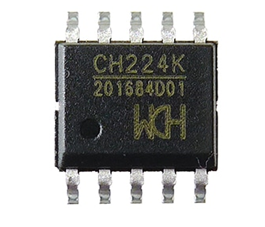
The CH224K USB-PD Sink Controller is a compact integrated circuit designed to negotiate power from USB Type-C chargers. It supports USB Power Delivery protocols and allows a device to request fixed output voltages such as 5V, 9V, 12V, 15V, and 20V. By handling communication through the CC pins, it ensures stable and controlled power delivery without requiring complex firmware or an external microcontroller.
This controller simplifies USB-C power design by using configurable pins or resistors to select the desired voltage level. It supports multiple PD standards and can handle high power levels up to 100W, making it suitable for efficient power management. Built-in protection features such as over-voltage and over-temperature protection help improve system safety and reliability.
If you are interested in purchasing the CH224K, feel free to contact us for pricing and availability.
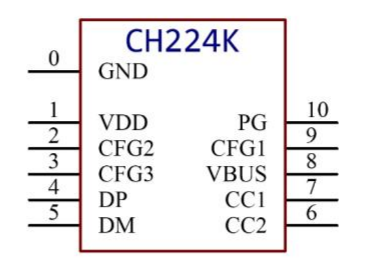
| Pin No. | Pin Name | Description |
| 1 | VDD | Power supply input for the chip |
| 2 | CFG2 | Configuration pin for voltage selection |
| 3 | CFG3 | Configuration pin for voltage selection |
| 4 | DP | USB data positive line (used for protocol detection) |
| 5 | DM | USB data negative line (used for protocol detection) |
| 6 | CC2 | USB Type-C Configuration Channel 2 for PD communication |
| 7 | CC1 | USB Type-C Configuration Channel 1 for PD communication |
| 8 | VBUS | Power input from the USB-C source |
| 9 | CFG1 | Configuration pin for voltage selection |
| 10 | PG | Power Good output signal |
| — | GND | Ground reference for the circuit |
| Specification | CH221K | CH224Q | IP2721 | HUSB238 | CYPD3174 |
| Protocol Support | PD 3.0/2.0 only | PD + QC + AFC | PD + QC + AFC | PD only | PD (programmable) |
| Input Voltage Range | 4V – 22V | 4V – 22V | 3.6V – 24V | 3V – 24V | Wide (depends on config) |
| Output Voltage Options | 5V / 9V / 12V / 15V / 20V | Same as CH224K | Flexible PD profiles | Fixed PD profiles | Fully programmable |
| Max Power Support | Up to 100W | Up to 100W | Up to 100W | Up to 100W | Up to 100W+ |
| Configuration Method | Resistor only | Resistor / Pin | Pin / I²C (varies) | Pin config | Firmware (MCU required) |
| External MCU Needed | No | No | Optional | No | Yes |
| Fast Charge Protocols | No | Yes | Yes | No | Limited |
| Protection Features | Basic | OVP, OTP | OVP, OTP | OVP, OTP | Advanced protections |
| Complexity Level | Very Low | Low | Low–Medium | Low | High |
| Package Type | Small SMD | DFN / SMD | SMD | SMD | QFN |
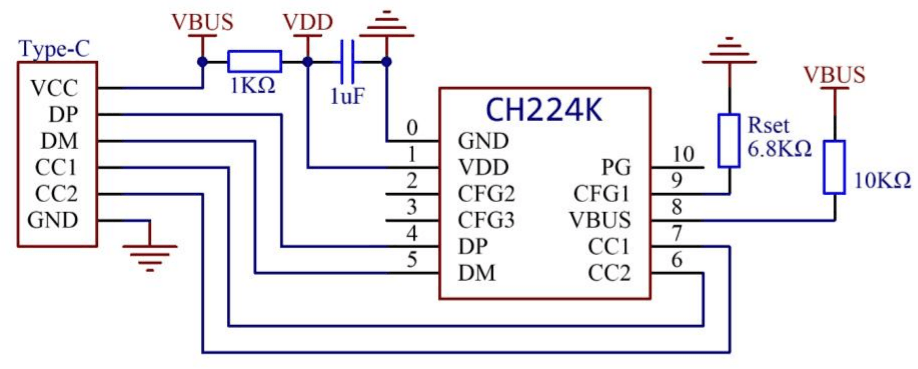
In this diagram, the CH224K operates by connecting to a USB Type-C source and controlling how power is received through the USB Power Delivery protocol. When the cable is plugged in, the VBUS line provides the input voltage, while the VDD pin powers the internal circuit of the IC. The capacitor helps stabilize the supply, and the series resistor limits current during startup to protect the device.
The CC1 and CC2 pins are linked to the Type-C interface and handle communication with the charger. Through these lines, the CH224K sends a request for a specific voltage level. The selected voltage depends on the configuration of the CFG1, CFG2, and CFG3 pins, which use external resistors to define the required output.
After successful negotiation, the charger supplies the requested voltage, and the PG (Power Good) pin goes active to indicate that the output is stable. This shows how the CH224K manages USB-C power delivery in a simple and controlled way without needing additional control logic.
• USB Power Delivery Support – Compatible with USB PD 2.0 and 3.0 for stable power negotiation
• Multiple Voltage Outputs – Supports 5V, 9V, 12V, 15V, and 20V selection
• High Power Capability – Handles up to 100W depending on the power source
• No MCU Required – Operates without a microcontroller, simplifying design
• Pin-Based Configuration – Voltage can be set using CFG pins or resistors
• Type-C Interface Support – Works directly with USB Type-C connectors via CC1 and CC2
• Fast Charge Protocol Support – Compatible with QC, AFC, and other protocols (variant dependent)
• Wide Input Voltage Range – Typically operates from around 4V to 22V
• Built-in Protection – Includes over-voltage protection (OVP) and over-temperature protection (OTP)
• Power Good Indicator – PG pin signals when output voltage is stable
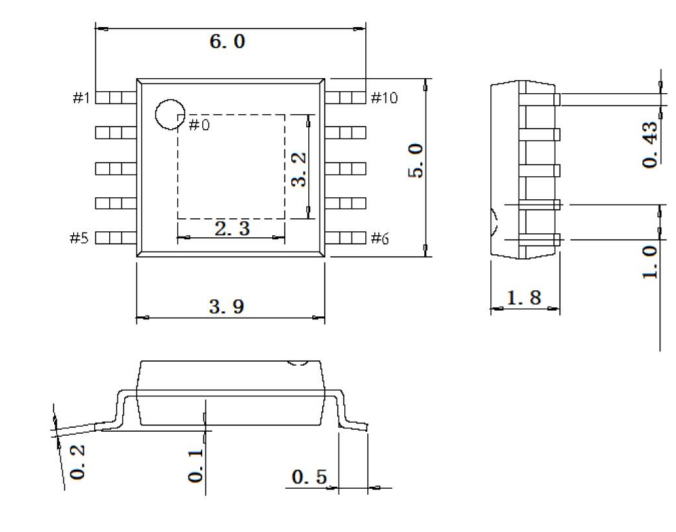
• Compact Package – Small SMD package (ESSOP-10) for space-saving designs
• Low External Components – Requires minimal additional parts for operation
• USB-C PD trigger modules
• Portable power supply boards
• Battery charging systems
• DIY adjustable voltage adapters
• Embedded system power input modules
• Laptop power conversion interfaces
• LED driver power input control
• Small electronics power regulation boards
• Fast-charging compatible devices
• Industrial control power interfaces
The CH224K USB-PD Sink Controller manage USB-C power delivery in a wide range of electronic designs. Its ability to negotiate multiple voltage levels, combined with simple configuration and built-in protection features, makes it a reliable choice for streamlined power management. The clear pin structure, easy integration, and availability of alternative ICs further enhance its flexibility for different design requirements. By understanding its schematic operation, specifications, and capabilities, designers can effectively implement stable and efficient USB-PD power systems.

 Catalogue
 FPGA / CPLD
 Memory
 MOS
MOS  MCU
MCU  DSP
DSP OCEP
OCEP Secondary
  Other
Other 


